- What do IS 303 and IS 710 actually mean?
- MR, BWR and BWP in plain words
- The Hyderabad answer and the Goa answer are not the same
- The one check almost nobody makes
- How the substitution actually happens
- What the core tells you, even though the glue does not
- What to write into the contract
- Where the money is genuinely better spent
- Plywood, MDF and chipboard are not competitors
- How we handle this at Simfy Homes
- When we are not the right fit
- Frequently asked questions
An ISI mark on a plywood sheet proves nothing on its own. The number printed beside it is the part that can be checked, and almost nobody checks it.
Plywood is the material where the gap between what you paid for and what arrived is widest, and hardest to see. It goes inside a wardrobe carcass, behind a kitchen shutter, under a wash counter. By the time it fails, the carpenter has moved on and the sheet cannot be identified.
This guide sets out what the Indian standards actually require, why the honest answer is different in Hyderabad and in Goa, and the one verification step that turns a printed claim into a checkable fact. It sits alongside our note on eco-friendly interior design in Hyderabad.
What do IS 303 and IS 710 actually mean?
They are two different Indian Standards for plywood. IS 303 is the everyday one. Inside it, MR means the glue only survives damp air, and BWR means it survives water. IS 710 is marine plywood. It uses a stronger glue, and to pass the test a sample is boiled in water for 72 hours without a break. That is the real difference between the two: how long the glue holds once it gets wet.
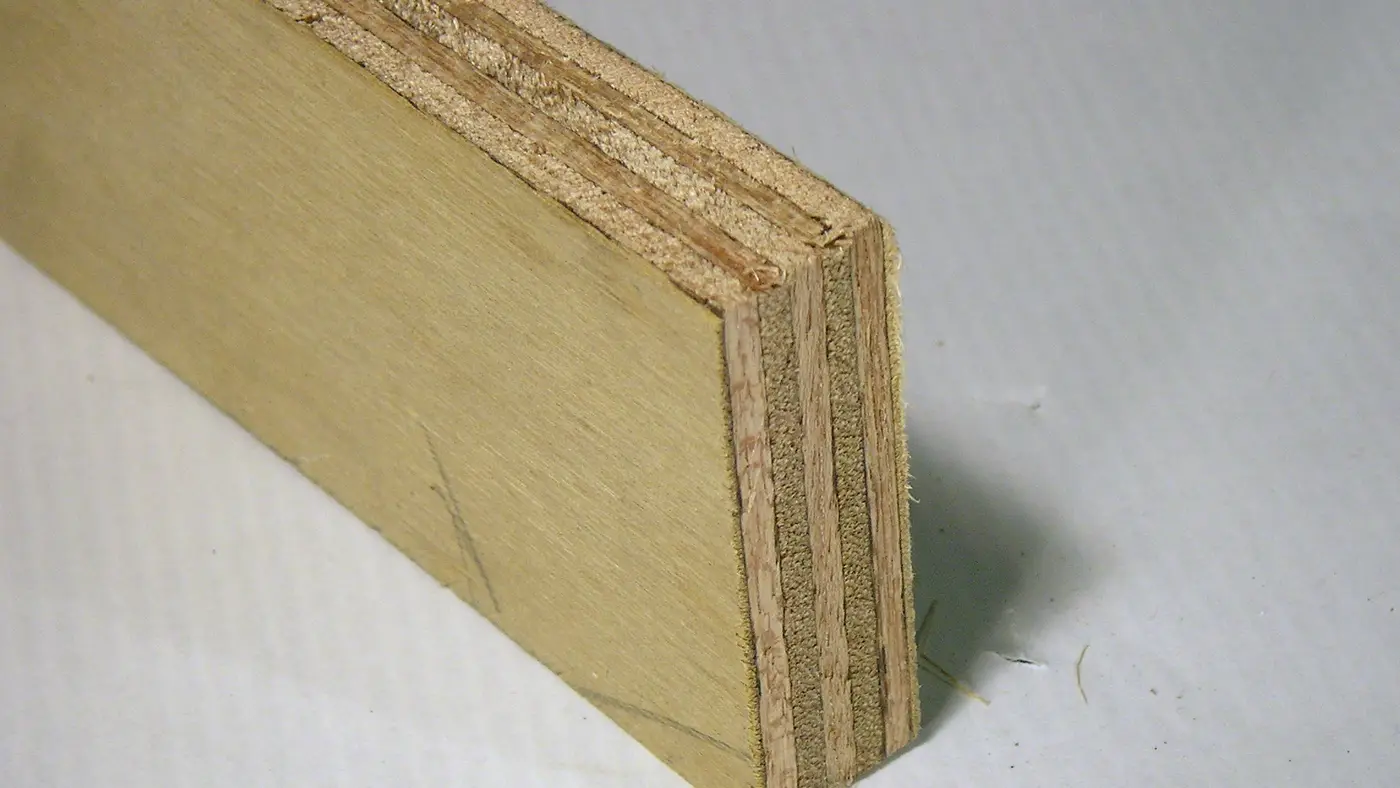
The numbers on a sheet are not brand tiers. They are the standard the sheet was made and tested against, and the difference between them is the glue and how hard it is tested, not the timber.
Infralens records IS 710 requiring a glue shear strength of 1,350 N average when dry, 1,100 N as an individual minimum, and 1,000 N average after the 72-hour boil, with moisture content between 5 and 15 per cent. Those numbers are the actual product of the standard. Everything a salesperson says about “waterproof” either traces back to them or does not exist.
MR, BWR and BWP in plain words
MR means moisture resistant, not water resistant. BWR means boiling water resistant. BWP means boiling water proof, which is the resin IS 710 requires.
PlyPrice sets out the test difference plainly. MR grade goes through three cycles of three hours at 60 degrees followed by 16 hours dry. BWR and BWP face three cycles of an eight-hour boil then 16 hours dry at 65 degrees. IS 710 goes further, with a continuous 72-hour boil.
Read that as three different lives. MR survives humidity. BWR survives repeated wetting. IS 710 survives being wet.
| Grade | Code | Test |
|---|---|---|
| MR | IS 303 | 3 cycles: 3h at 60°C, then 16h dry |
| BWR / BWP | IS 303 | 3 cycles: 8h boil, then 16h dry at 65°C |
| Marine (BWP resin) | IS 710 | 72h continuous boil |
PlyPrice also notes that the 2024 revision of IS 303 brought BWP into that standard, which is why a sheet can now carry BWP without carrying IS 710. Ask which standard the sheet is certified to, not only which letters are printed on it.
The Hyderabad answer and the Goa answer are not the same
In Hyderabad, BWR through the wet areas and MR elsewhere is a defensible specification. In Goa, coastal humidity makes that same specification a false economy.
This is the part the national buying guides cannot tell you, because they are written for the whole country at once. Hyderabad is a dry inland city with two or three wet months. A wardrobe in a first-floor bedroom is not fighting moisture in any meaningful way, and MR there is an honest choice rather than a corner cut.
Goa is a different building. Salt air, months of monsoon, and interiors that never fully dry between June and September. The same wardrobe in the same position is in a materially harsher environment, and the sheet that survives it is a boiled-and-tested one. Our note on building through the Goa monsoon covers the wider version of that difference.
Where both places agree is water-adjacent joinery. Kitchen base joinery, vanity carcasses, the bottom shelf of anything near a bathroom wall. Those take the higher grade wherever the house is, because the failure there is not weather, it is plumbing.
The one check almost nobody makes
An ISI mark is a claim. The licence number beside it is what can be checked. The Bureau of Indian Standards states that its BIS Care app lets a consumer “check the authenticity of the Product with ISI mark by using Verify Licence Details”.
That single sentence is the most useful thing in this guide. The mark can be printed by anyone with a stamp. That number is issued by BIS, is tied to a specific manufacturer and a specific standard, and either resolves in their system or does not.
BIS also states the same app lets you “register complaints regarding quality of Product of misuse of BIS standard marks”. Which means the check is not only a check. It has somewhere to go when it fails.
Do it once, on site, on the actual pallet that arrived — not on the sample sheet you were shown in the showroom, which is very often a different sheet entirely.
How the substitution actually happens
- Sample versus delivery. The approved sample is genuine. The pallet that lands two months later is not, and nobody compares them.
- The mark without the number. A logo screen-printed on the edge with no licence number at all, or one that resolves to a different product category.
- Grade printed, standard absent. “BWR” stamped on a sheet with no IS number anywhere, which commits the seller to nothing.
- Mixed pallet. Genuine sheets on the outside, something else in the middle of the stack.
- Grade dropped where it will not show. The visible wardrobe in BWR, the kitchen carcass behind the shutters in MR.
- Thickness under tolerance. A sheet sold as 18 mm arriving at 16.5, which is a quiet 8 per cent of the material gone.
None of these need a dishonest carpenter. Most happen because nobody at any point wrote down what was supposed to arrive, so nothing that arrived was ever wrong.
What the core tells you, even though the glue does not
You cannot see the adhesive. You can see the core, and a poor core is a reliable sign of a sheet built down to a price.
Look at the cut edge. The inner veneers should sit tight against each other with no visible voids. Gaps in the core are where screws lose their grip, where a shelf develops a sag it never had on day one, and where moisture travels once it gets in anywhere.
Feel the face for flatness and press the edge with a thumbnail. A soft, spongy edge means low-density timber in the core regardless of what the face looks like. Weigh a sheet if you can — density is one of the few honest indicators available without a laboratory.
None of this replaces the standard and the licence check. It is the thirty-second version you can do while the delivery is still on the truck, and it catches the worst material before it is unloaded, which is a far easier conversation than catching it after.
What to write into the contract
Specify the standard, the grade, the thickness and the brand, and require the delivery to be photographed with its markings legible.
A line that says “branded plywood” is not a specification. A line that says “IS 710 marine grade, 18 mm, in kitchen base units and all wash counter carcasses; IS 303 BWR, 18 mm, in bathroom-adjacent joinery; IS 303 MR, 18 mm, elsewhere” is one, and it takes the argument out of the room before it starts.
Add two more clauses that cost nothing. Photographs of every pallet on arrival with the edge markings readable. And the right to verify those numbers on site, with rejection at the supplier’s cost if they do not resolve. Our construction contract checklist covers the same discipline across the rest of the job.
Two quotes are only comparable once both name the standard, the grade and the thickness by location. Most do not.
Where the money is genuinely better spent
- Everything below the worktop. Kitchen base joinery takes the highest grade, always. This is where leaks live.
- Vanity carcasses. Constant splash, constant humidity, and the failure stays invisible until the shutter drops.
- Bathroom-adjacent walls. Any joinery sharing a wall with a wet area, on either side of it.
- The lowest shelf everywhere. Floor-level moisture from mopping ends careless carcasses before anything else does.
- Coastal work, throughout. In Goa the whole house behaves like a wet area for four months a year.
And where it is not: the back panel of a wardrobe in a dry bedroom, the inside of a study unit, an overhead loft. Upgrading those buys very little, and the money moves better into the hardware, which is the other thing that decides whether joinery feels expensive in ten years.
Plywood, MDF and chipboard are not competitors
They fail differently. Plywood swells and can sometimes be dried out. MDF absorbs water and turns to pulp. Chipboard does the same, faster.
MDF has a real place — it is dimensionally stable and takes a lacquer finish better than plywood ever will, which is why good shutters are often MDF on a plywood carcass. That combination is a considered choice, not a compromise.
What is a compromise is a chipboard carcass in a kitchen, sold on the strength of the shutter you can see. Ask what the box is made of, not what the front is finished in.
How we handle this at Simfy Homes
Grades are written into the schedule by location before any joinery is ordered — which rooms take marine, which take BWR, which take MR — so the decision is made once on paper rather than sheet by sheet on site. Deliveries are photographed with their edge markings legible, and licence numbers are checked against BIS on the material that actually arrived.
We say plainly where the higher grade is not worth it, because a specification that upgrades everything is as unhelpful as one that upgrades nothing. It just costs more to be wrong. If you are planning interiors in Hyderabad or Goa and want the material schedule settled before quotations are compared, talk to our team.
When we are not the right fit
If you have a carpenter you trust and you are buying the sheets yourself, you do not need us for this. Take the standards, the grades and the licence check from this page and run it yourself; it is not complicated and the check takes a minute. Where we earn our place is on projects large enough that nobody can personally watch every pallet, which is exactly where written schedules and photographs replace supervision.
Frequently asked questions
What is the difference between IS 303 and IS 710 plywood?
IS 303 is the standard for general plywood in MR and BWR grades. IS 710 is the marine plywood standard, requiring boiling water proof phenol-formaldehyde bonding and a 72-hour boiling water test. Infralens records IS 710’s glue shear requirement as 1,350 N average dry and 1,000 N average after the boil.
Is BWR the same as waterproof?
No. BWR stands for boiling water resistant. PlyPrice sets its test at three cycles of an eight-hour boil and 16 hours dry at 65 degrees, against IS 710’s continuous 72-hour boil. BWR survives repeated wetting; it is not the grade for something that will sit wet.
How do I check the mark is genuine?
Through the licence number, not the logo. The Bureau of Indian Standards states its BIS Care app lets you check the authenticity of a product with an ISI mark using “Verify Licence Details”, and lets you register complaints about misuse of BIS standard marks. Check the pallet that arrived, not the showroom sample.
Do I need marine plywood throughout the house?
In Hyderabad, no. Kitchen base joinery, vanity carcasses and bathroom-adjacent units justify it; a dry bedroom wardrobe does not. In Goa the calculation shifts, because coastal humidity and a long monsoon mean far more of the house behaves like a wet area.
What thickness should carcasses be?
Carcass thickness follows span, load and the hardware being used rather than a single universal figure, so it belongs in the joinery drawings. What matters as much is that the delivered thickness matches the specified one — under-tolerance sheets are a common and quiet substitution.
Is MDF worse than plywood?
Different, not worse. MDF is more dimensionally stable and finishes better, which is why lacquered shutters are often MDF. It handles water badly, so it belongs on shutters and profiles rather than in carcasses near water. Chipboard in a kitchen carcass is the one to refuse.
Can I tell the grade by looking at a sheet?
Not reliably. Core gaps and face quality tell you something about the veneers, but the glue is what separates the grades and the glue is invisible. That is precisely why the standard, the BIS number and the delivery photograph matter more than an inspection by eye.
What should the contract say about plywood?
The standard, the grade, the thickness, the brand and the location each applies to, plus photographs of every delivery with markings legible and the right to reject material whose BIS number does not resolve. Written that way, substitution stops being an argument about memory.
One accountable team from the first sketch to handover, with deliveries photographed and material checked against what was specified.

The Simfy Homes teamSimfy Homes designs and builds bespoke homes, villas and interiors across Hyderabad and Goa, with one accountable team from first sketch to handover.