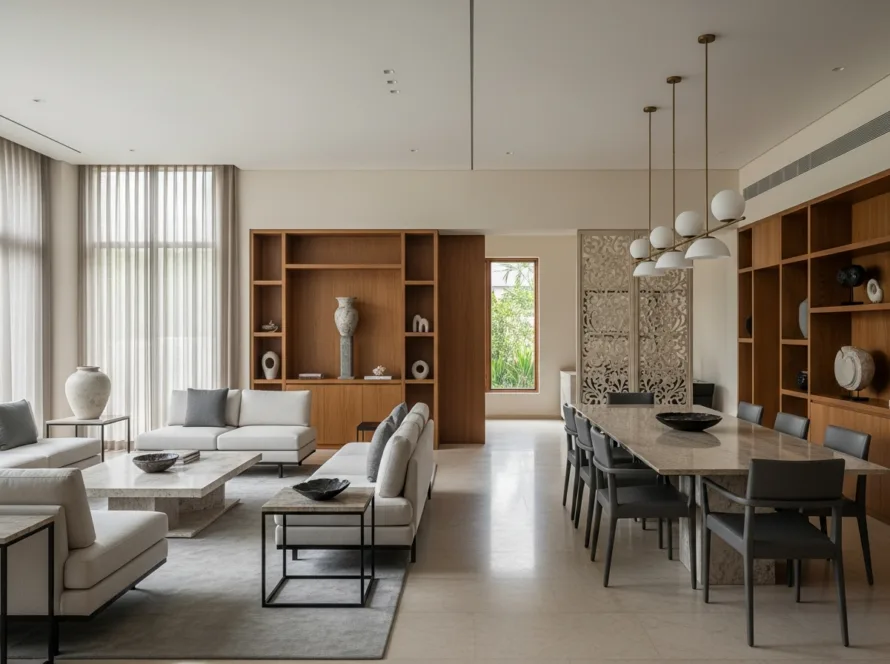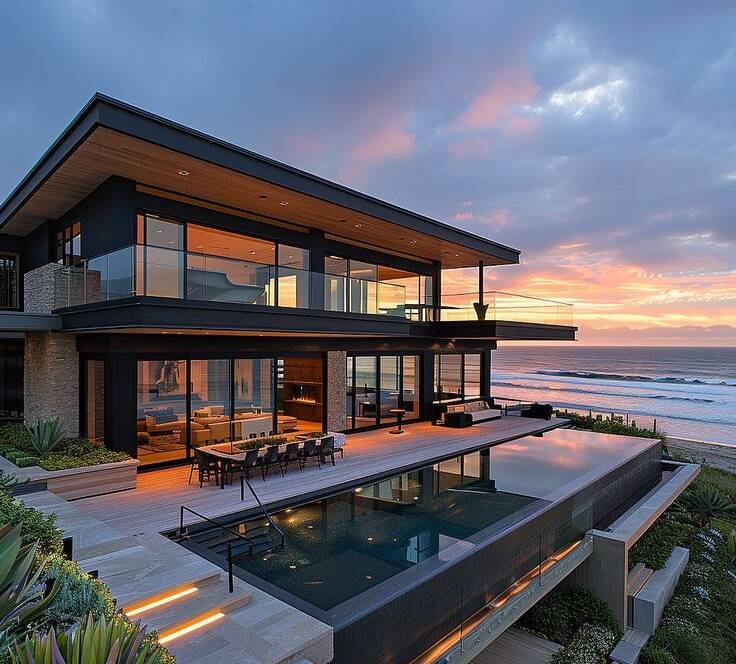


- What does eco friendly interior design in Hyderabad actually mean?
- Why does the ISI mark on your plywood say nothing about the air in your bedroom?
- What is biophilic interior design, and does it survive a Hyderabad summer?
- Which eco materials last in Hyderabad, and which quietly fail?
- How do you specify low-VOC finishes so that site actually delivers them?
- Is an IGBC or GRIHA rating worth chasing for a private home?
- What changes from Banjara Hills to Kokapet?
- How we handle this at Simfy Homes
- When we are not the right fit
- Common questions
- Where to start
The first thing you notice in a newly finished flat is not the marble. It is the smell.
That sharp, sweetish edge in the air on handover day is not “new house smell”. Some of it is solvent leaving the paint. Some of it is formaldehyde leaving the plywood behind your wardrobe shutters. It fades over weeks, sometimes over months, and the whole time your family is breathing it in a room the air conditioner keeps sealed shut.
This is the part of eco friendly interior design in Hyderabad that almost nobody writes about. The topic gets covered as jute rugs, cane pendant lights and a wall of money plants. Those are decoration decisions. The decisions that actually matter are made on a materials sheet weeks earlier, in language most homeowners never see.
This guide is about those decisions. What to specify, what the certifications actually promise, which “green” materials quietly fall apart in Hyderabad’s climate, and how to check that the board delivered to site is the board you paid for. If you are still choosing who will run the work, our note on how to choose an interior designer for a flat in Hyderabad covers that side of it.
What does eco friendly interior design in Hyderabad actually mean?
It means three things at once: materials that do not give off fumes into sealed, air-conditioned rooms; materials that survive 38°C summers and a humid monsoon without bending out of shape or coming apart in layers; and design that reduces the cooling load so the home runs on less power for the next twenty years. Decoration comes last, not first.
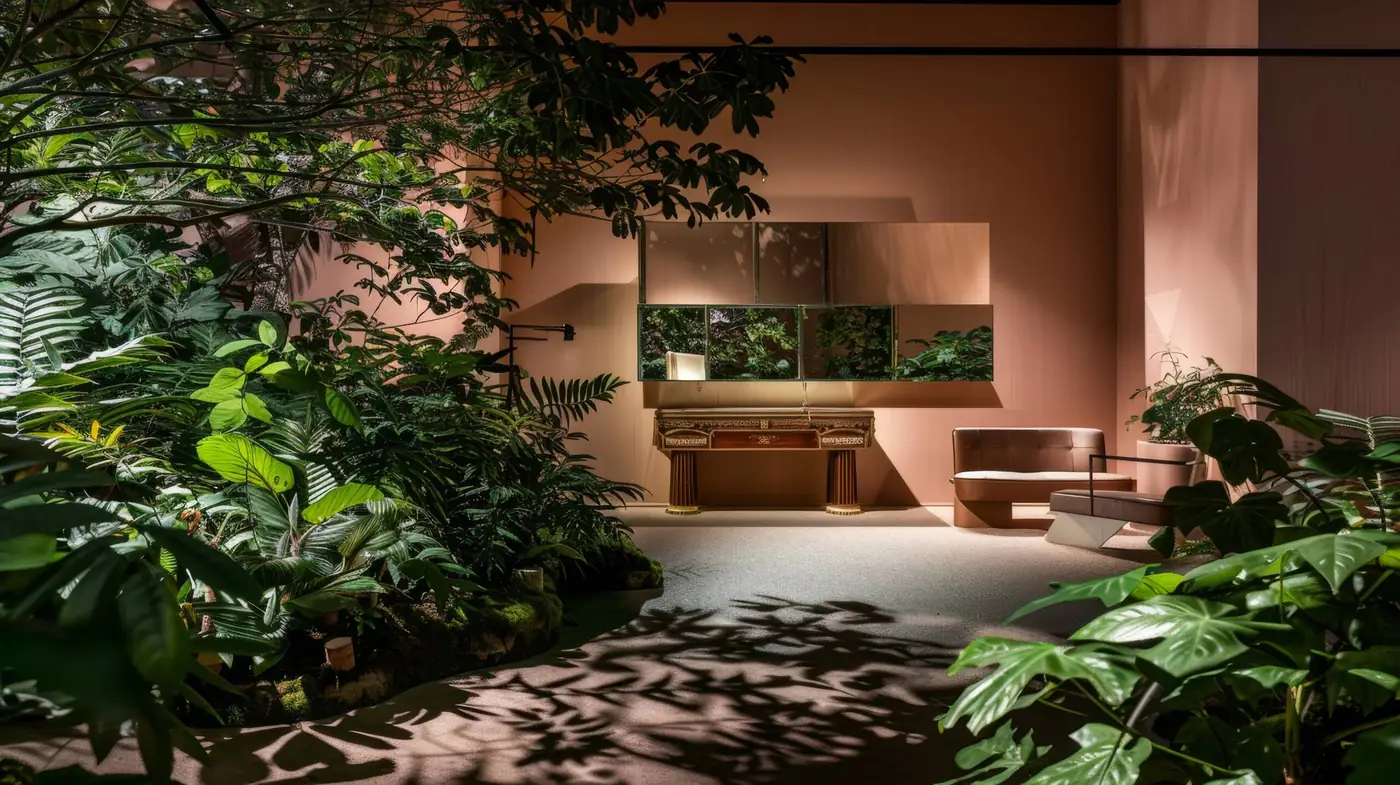
Most articles on this subject treat “eco” as a look. Reclaimed wood, cane, linen, plants. That is a style, and it is a pleasant one, but it is not what makes an interior sustainable. An interior is sustainable when it lasts. A jute rug that has to be replaced in three years because the monsoon rotted it is worse for the planet than a good wool one that lasts fifteen. The same logic applies to every surface in the house. Longevity does more for the environmental cost of a fit-out than any single material choice, and it is decided by whether the material suits the climate it has to live in. The second lever is what you breathe, because a modern Hyderabad home is closed and cooled for six months of the year, and whatever the finishes release has nowhere to go. The third is the cooling load itself — orientation, shading, glass, and where you put the heavy stuff. Everything else is preference.
Hyderabad makes this specific. According to climate records compiled by climate-data.org, the average maximum sits at about 36.9°C in April and 37.8°C in May. The same climate-data.org records put annual rainfall near 745mm, with roughly 551mm of it falling between June and September, and relative humidity climbing near 78% by September. Those are aggregated records rather than official India Meteorological Department normals, so treat them as the shape of the year rather than a precise figure. The shape is the point: the material has to handle a bone-dry 38°C in May and a saturated September, four months apart, in the same joint.
That swing is what breaks interiors here. Not use. Movement.
Why does the ISI mark on your plywood say nothing about the air in your bedroom?
Because IS 303, the Indian standard your carpenter points to, is a specification for glue strength and water resistance. It grades how the board behaves in water. It contains no requirement or test for formaldehyde emission at all. A fully compliant ISI-marked board can off-gas freely and still be entirely within standard.
This is the single most useful thing to understand before you sign a materials sheet, and not one of the pages currently ranking for this topic mentions it. IS 303:1989, “Plywood for General Purposes — Specification”, defines MR (moisture resistant) and BWR (boiling water resistant) grades and tests them by bond quality and water resistance — MR in water at 60±2°C for three hours, BWR in boiling water for eight hours (IS 303:1989 specification summary). Both grades are bonded with formaldehyde-based adhesives — urea formaldehyde for MR, phenol formaldehyde for BWR. The standard says nothing about how much of that formaldehyde later leaves the board and enters the room. Emission is graded by a completely separate system, and that system is voluntary in India. So “ISI marked” and “low emission” are two different claims, and only one of them is usually being made.
The emission grades are worth knowing by name, because they are what you write into the specification. E1 and E0 are the two you will hear quoted — E1 the common low-emission grade, E0 the stricter one. A plywood certification guide published by PlyPrice puts the figures suppliers quote against a desiccator test in the region of 1.5 mg/L for E1 and 0.5 mg/L for E0, and notes that India has no mandatory emission norm of its own. Treat those numbers as the trade’s shorthand rather than as law. Because there is no mandatory norm, E0 and E1 are voluntary claims a supplier chooses to make and you choose to verify — which is exactly why the certificate matters more than the label.
Why this matters enough to argue about: according to the World Health Organization’s 2010 indoor air quality guidelines, the short-term guideline for formaldehyde is 0.1 mg/m³ over 30 minutes, set to prevent sensory irritation in the general population. The same WHO review notes that IARC classifies formaldehyde as a Group 1 human carcinogen, with sufficient epidemiological evidence linking it to nasopharyngeal cancer (WHO, formaldehyde chapter).
None of that means a plywood wardrobe will hurt your family. It means the difference between an unmarked board and an E1 board is a real difference in what a closed bedroom holds, and it costs you one line in a specification to ask for it. Nobody will offer it. You have to write it.
What is biophilic interior design, and does it survive a Hyderabad summer?
Biophilic interior design brings daylight, natural materials, views and greenery indoors because people respond to them physically. In Hyderabad it works — but only if the daylight is shaded daylight. An unshaded west window in Kokapet delivers glare and heat, not calm, from March through May.
The idea behind biophilic interior design in Hyderabad is straightforward: our nervous systems settle around natural light, natural texture, moving air and living things. So you design for those instead of adding them at the end. In practice that means a plan where the rooms you use in the evening face the softer light, deep sills or louvres on the western side, materials you can feel the grain of, and a real relationship between an indoor room and an outdoor one — a courtyard, a deep balcony, a planted setback. Done properly it changes how a house feels within a few seconds of walking in, and it costs almost nothing extra because it is a planning decision rather than a purchase. Done as decoration — a green wall in a dark corridor, a water feature in a sealed lobby — it becomes a maintenance liability within a year. The difference is whether the nature is structural to the plan or stuck on afterwards.
There is a measured argument for taking the air side of this seriously. In the COGfx Study, researchers at Harvard’s T.H. Chan School of Public Health recorded cognitive function scores 61% higher in a “green” condition and 101% higher in an enhanced condition than in a conventional one. The Harvard team ran 24 knowledge workers through simulated office days, holding total VOCs under 50 µg/m³ and CO₂ at 600 ppm in the enhanced condition, against 950 ppm in the conventional one. Twenty-four people is a small sample and it was an office, not a home — treat it as a strong signal, not a promise. But the direction is clear enough: low-emission finishes plus real ventilation is not a soft benefit.
One honest correction, because almost every article on this subject repeats the opposite. Potted plants do not meaningfully clean your air. According to Drexel University researchers Cummings and Waring, you would need between 100 and 1,000 plants per square metre of floor area to match the VOC removal of a building’s air handling system, or of simply opening a couple of windows. Their review of a dozen studies across thirty years was published in the Journal of Exposure Science and Environmental Epidemiology.
Keep the plants. They are good for how a room feels and how you feel in it. Just do not let anyone sell them to you as air purification, and do not let them replace the two things that actually work: low-emission materials and moving air.
Which eco materials last in Hyderabad, and which quietly fail?
Materials fail here at the joints, not the surfaces. Anything that absorbs moisture and swells — untreated bamboo, low-grade engineered board, natural fibre in a wet area — moves through the 40°C-to-monsoon swing until the joint opens. The greenest material in the world is the one you never have to replace.
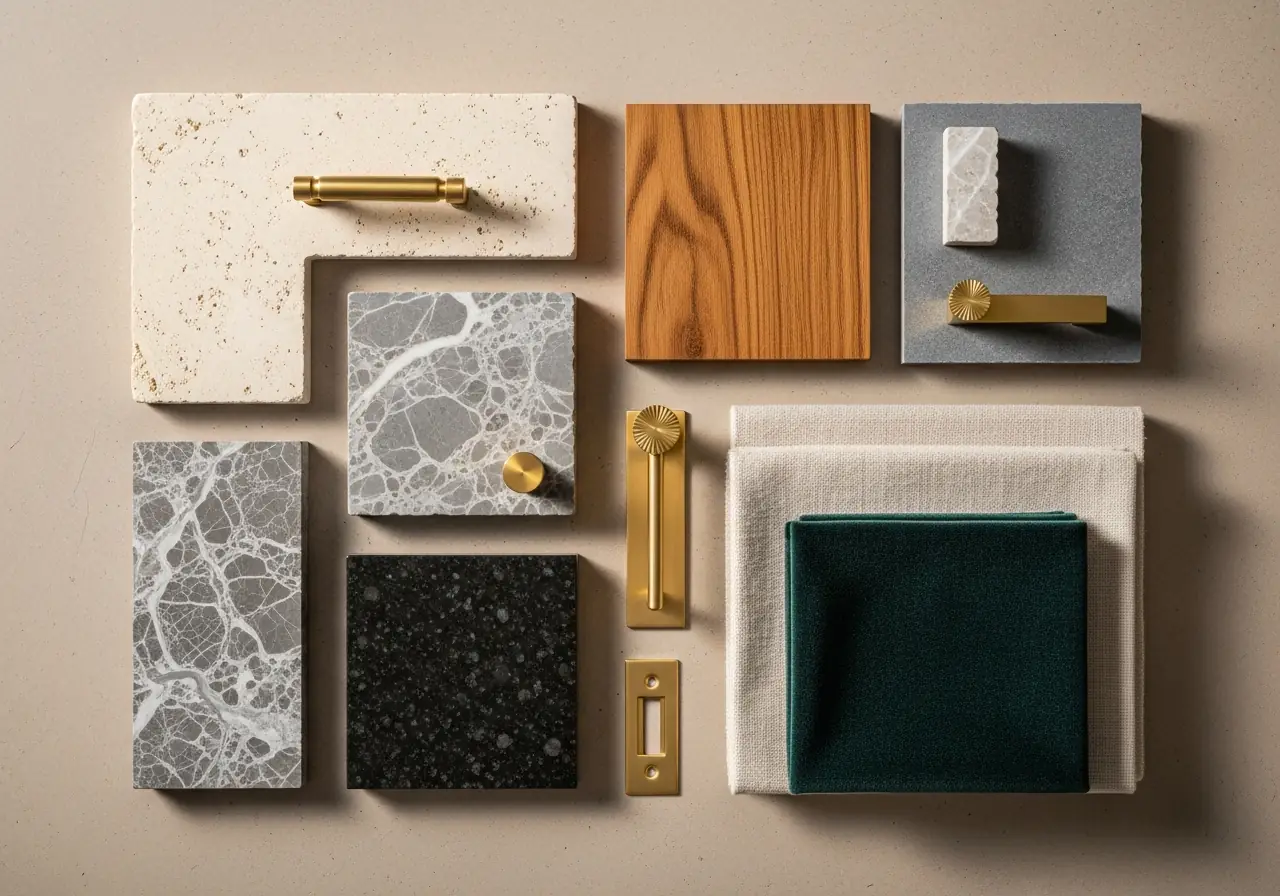
Sustainable interior design in Hyderabad has a specific failure mode, and it is seasonal movement. Between a dry May afternoon and a humid September morning, hygroscopic materials take on and give up moisture, and every cycle works the joint a little looser. In a villa this shows up as wardrobe shutters that stop aligning by the second monsoon, skirting that lifts, and veneer that bubbles near the bathroom wall. None of it is a workmanship failure in the way homeowners assume. It is a specification failure — the wrong board grade in the wrong room. Which is why the eco conversation and the durability conversation are the same conversation. Choosing a beautiful reclaimed teak for a dry bedroom wall is a genuinely sustainable decision. Choosing the same material for a utility area next to a washing machine is a decision to redo it. The table below is the shortlist we work from, and the right-hand column is the part people skip.
| Material | Where it earns its place in Hyderabad | Where it quietly fails |
|---|---|---|
| Reclaimed / salvaged solid teak | Dry bedrooms, studies, feature panelling, doors. Already fully seasoned, so it moves less than fresh timber. | Kitchens and bathrooms unless properly sealed on all six faces, including the hidden back. |
| FSC-certified new timber | Anywhere solid wood is right, with a traceable claim behind it. | When the “FSC” claim is verbal. The certificate belongs to the supplier, not the species. |
| Bamboo (engineered, pressed) | Flooring and shelving in dry, shaded rooms. Fast-renewing and genuinely hard-wearing. | Bathrooms, open balconies, and anything in direct west sun. It swells, then it cups. |
| BWP / marine-grade board, E1 or E0 rated | Kitchens, utility, vanity units, any carcass touching a wet wall. | Being sold on the ISI mark alone. Ask for the emission grade separately. |
| Lime plaster and mineral paints | Breathable walls in older Banjara Hills and Jubilee Hills homes with thick masonry. | Over modern gypsum-skimmed walls, where the breathability has nowhere to go. |
| Natural stone (local Tandur, Kota, granite) | Floors and counters. Locally quarried, so transport emissions are low, and it outlives the building. | Nowhere structurally — but polished stone in a west-facing living room stores heat all evening. |
| Jute, sisal, coir | Dry bedrooms and dressing areas. Renewable and repairable. | Ground-floor rooms during monsoon, and anywhere a plant is watered above them. |
The FSC line is worth expanding, because it is the most commonly misused claim in Indian interiors. FSC chain of custody certification tracks certified forest material through every step of the supply chain, and the label on a finished product means each step in that chain met the requirement (Forest Stewardship Council). It is a documentation trail, not a description of the wood. If nobody can produce the chain-of-custody number, there is no claim — there is a preference.
How do you specify low-VOC finishes so that site actually delivers them?
Write the limit, not the adjective. “Low-VOC paint” is unenforceable. A number in g/L, on the bill of quantities, with the empty tins retained for inspection, is enforceable. The gap between what is specified and what arrives is the entire problem, and it is closed with paperwork.
Every fit-out in this city runs on the same quiet substitution. The specification says one thing, the site buys another, and by the time the room is painted nobody can tell the difference by looking. This is not usually dishonesty. It is a painter who ran short on a Saturday, bought locally, and matched the shade. The finish looks identical. The emissions are not. The only defence that has ever worked for us is making the specification checkable by a person standing in the room — a number, a printed grade, and physical evidence that survives after the work is done. GRIHA, India’s own rating system, publishes a usable reference point: its VOC limit for wall primer is under 50 g/L (GRIHA Help Centre). Adopt limits like that as your own contract language and the conversation stops being about intentions.
Here is the practical version — the left column is what people say, the right is what makes it real.
| What is usually written | What to write instead | How you verify it on site |
|---|---|---|
| “Eco-friendly / low-VOC paint” | Named product, with the VOC content in g/L stated for primer and topcoat | Keep every empty tin until handover. Photograph the labels. |
| “ISI plywood” | IS 710 BWP for wet areas, IS 303 BWR elsewhere, plus E1 emission grade minimum | Emission grade printed on the board face, and the supplier’s test certificate. |
| “Good quality adhesive” | Low-formaldehyde adhesive named on the BOQ, with quantity | Match tins consumed against the area covered. |
| “Sustainable / certified wood” | FSC chain-of-custody certificate number from the supplier | The number is verifiable against the FSC database. |
| “Well-ventilated during work” | Fixed flush-out period after painting and polishing, written into the programme | It appears on the schedule, so nobody is asked to move in early. |
| “Energy-efficient lighting” | Wattage and lumen output per fitting, listed room by room | Add it up before ordering, not after the bill arrives. |
The flush-out line is the one people drop, and it is free. Solvent and adhesive emissions are highest immediately after application. Leaving a finished home closed and cooled for a week before anyone sleeps in it is a scheduling decision, not a cost. It is also the point where a contractor under pressure to hand over will push back — which tells you exactly how much it matters.
This is the same discipline we apply on the construction side, where the checks happen before things get covered up. We wrote about that in more detail in our piece on sustainable home construction in Hyderabad.
Is an IGBC or GRIHA rating worth chasing for a private home?
Usually not, and it is worth saying plainly. IGBC’s Green Interiors rating is designed for tenant-occupied commercial spaces — offices, retail, hotels, restaurants. For a private residence, borrow its criteria as a checklist and skip the certification. You get the substance without the process.
The IGBC Green Interiors rating system addresses six areas: eco design approach, water conservation, energy efficiency, interior materials, indoor environment, and innovation in interior design. Certification runs from Certified at 50–59 points up to Platinum at 80–100 for new projects, and the system is explicitly framed for tenant-occupied commercial fit-outs (Indian Green Building Council). Those six headings are a genuinely good structure to plan a home against — they cover the things that matter in roughly the right order. But the certification itself is built around a commercial documentation cycle, and for a single private residence the effort tends to go into the paperwork rather than into the house. Our honest position: use the framework, put the money into better boards, better glass and better shading, and let the home be quietly good rather than formally rated.
Every material decision on this page is made before a single sheet is cut. See how it looks finished.
What changes from Banjara Hills to Kokapet?
Orientation and building age change everything. Older bungalow plots in Banjara Hills, Jubilee Hills and Film Nagar have mature trees and thick masonry, which lets you design with breathable finishes and real daylight. New high-rise apartments in Kokapet, Gachibowli and HITEC City have large sealed glass and no shade, so the work moves to controlling heat and glare.
In the older neighbourhoods the opportunity is the site itself. A Banjara Hills or Film Nagar plot with grown trees on the western boundary is already doing the shading work, and thick load-bearing walls hold their temperature through the afternoon. Lime plaster, mineral paint and solid timber behave well against that kind of wall, and a courtyard or deep verandah reconnects the plan to the outside. In the newer towers the situation reverses. Floor-to-ceiling glass on a west face in Kokapet or Gachibowli will make a living room unusable between three and six in the afternoon in April and May, and no amount of natural material fixes that. There the sustainable decisions are unglamorous — solar-control film or double glazing, honest full-height curtains on a track that clears the glass, light-coloured floors that do not store heat, and lighting layered low so you are not running a ceiling grid all evening.
The same is true of storage. In a HITEC City apartment where the kitchen shares a wall with a bathroom, the carcass grade on that one run of units decides whether you are looking at swollen shutters in year three. It is a small increment per sheet and it is invisible for a decade. That is what most of this work is.
If you are working on a villa rather than an apartment, the levers are different again — larger envelope, more glass, more orientation to control. We cover that in our page on villa interior design in Hyderabad.
How we handle this at Simfy Homes
We are a design-and-build practice, which means the person who wrote the specification is the same team answering for what arrives on site. That is the only reason any of the above is enforceable. When design and execution sit with different companies, the emission grade on a materials sheet becomes a suggestion.
Practically, three things: the materials sheet carries grades and limits rather than adjectives; the flush-out period sits on the programme before handover, not after someone asks for it; and the empty tins and board certificates stay on site so a claim can be checked rather than believed. Clients working from Dubai, Singapore or the US get the same record set, photographed, because they cannot walk the site.
Kingston Park and Ridhira Zen are finished and you can walk through them. Golecha Ghar is under construction right now, which is often the more useful visit — you can see what a carcass looks like before it is covered. You can see the full list on our projects page, and how we approach the work under our interior design work in Hyderabad.
When we are not the right fit
If you want the look without the specification, we are the wrong team, and you will find us tiring. A cane-and-linen interior built on unmarked board will photograph exactly as well as one built properly, at a lower number, and several capable studios in the city will do it well.
If your programme cannot absorb a flush-out period before move-in, we will keep raising it, and that becomes friction.
And if the project is a partial refresh — repainting, changing soft furnishings, replacing a few pieces — a full design-and-build engagement is more machinery than the job needs. Say so early and we will tell you honestly whether it is worth starting.
Where it does fit, the conversation is short and specific. Talk to our team with your floor plan and the orientation, and we can tell you within one meeting where the heat and moisture problems are going to be.
Common questions
Is eco friendly interior design suitable for an apartment, or only for independent villas?
It suits apartments better in some ways, because the decisions concentrate. You cannot change the building’s orientation or glass, so the work moves to the things you control — board grades, finishes, shading at the window, and lighting. Those are exactly the decisions with the biggest effect on air quality and durability inside a sealed, cooled flat.
Does low-VOC paint really smell less, and how long before a room is safe to sleep in?
Yes, noticeably, though “low odour” and “low VOC” are marketed as the same thing and are not. Odour is what you smell; VOC content is what is measured, in g/L on the tin. Either way, emissions are highest right after application, so keep the room ventilated and leave a flush-out period before anyone sleeps there. Write it into the schedule so it does not get skipped.
Is bamboo a good material for Hyderabad interiors?
In the right room, yes. Pressed engineered bamboo is hard, fast-renewing and holds up well in dry, shaded areas — bedroom flooring, shelving, panelling. It is a poor choice for bathrooms, open balconies and anything sitting in direct west sun, because it takes on moisture and then cups. Use it where it is dry and it will outlast most alternatives.
How do I know my carpenter actually used E1 or E0 plywood and not something unmarked?
Look at the board face before it is cut. The emission grade is printed on it, separately from the ISI mark, and the supplier should be able to produce a test certificate. Ask for one full sheet to be kept aside uncut until the work is signed off. Anyone supplying the right board has no reason to object.
Do indoor plants improve air quality in a closed, air-conditioned home?
Not measurably. According to a Drexel University review of thirty years of studies, you would need roughly 100 to 1,000 plants per square metre of floor space to match what a building’s ventilation, or two open windows, already does. Keep plants because rooms feel better with them. For air, rely on low-emission materials and actual ventilation.
Does eco friendly interior design cost more than conventional interiors?
Some line items move up, some move down, and the total depends far more on scope than on the eco decisions. Emission-graded board and named low-VOC paint are small increments on a sheet. Where money genuinely shifts is durability — better shading, better glass, better carcass material in wet zones. That spend usually returns as work you do not have to redo in year three.
Can this work if I am overseas and cannot visit the site?
It can, but only if the record-keeping is built in from the start. Board grades and paint labels have to be photographed as materials land, not reconstructed later from memory. Ask for a dated photographic record of what arrived, keyed to the materials sheet. If a team cannot produce that, remote supervision is not really supervision.
Will an eco friendly fit-out take longer than a conventional one?
The construction time is broadly the same. What genuinely adds days is the flush-out period after painting and polishing, and any wait for a specific board grade that is not stocked locally. Both are known in advance and belong on the programme from day one. Delays happen when they are discovered late, not when they are planned.
Where to start
If you take one thing from this, take the plywood point. The mark most people rely on grades a board against water, not against the air in a closed bedroom, and the emission grade is a separate line you have to ask for by name. That single question changes the quality of every conversation you have with a supplier afterwards.
When you are ready to look at your own plan, our page on home interior design in Hyderabad covers how we work through a project from drawings to handover.
Sources
- World Health Organization — WHO Guidelines for Indoor Air Quality: Selected Pollutants (2010), Executive Summary: https://www.ncbi.nlm.nih.gov/books/NBK138699/
- World Health Organization — formaldehyde chapter, IARC Group 1 classification: https://www.ncbi.nlm.nih.gov/books/NBK138711/
- IS 303:1989, Plywood for General Purposes — Specification, grades and test scope: https://infralens.in/code/IS-303-1989
- Plywood certification comparison — E0 and E1 grades as quoted by suppliers, and their voluntary status in India: https://www.plyprice.com/blog/plywood-certifications-explained
- GRIHA Help Centre — VOC limit for wall primer: https://helpcentre.grihaindia.org/hc/en-us/articles/360000284493
- Indian Green Building Council — IGBC Green Interiors rating system, categories and thresholds: https://igbc.in/igbcgreeninteriors/
- Forest Stewardship Council — chain of custody certification: https://fsc.org/en/chain-of-custody
- The COGfx Study, Harvard T.H. Chan School of Public Health — cognitive function scores under varied air conditions: https://thecogfxstudy.com/study-1/cognitive-function-tests-scores-doubled/
- Drexel University — Cummings & Waring, Journal of Exposure Science and Environmental Epidemiology, potted plants and VOC removal: https://drexel.edu/news/archive/2019/november/potted-plants-do-not-improve-air-quality
- Hyderabad climate records (aggregated averages, not official IMD normals) — temperature, rainfall and humidity: https://en.climate-data.org/asia/india/hyderabad/hyderabad-2801/
Send us your floor plan and the orientation. We will tell you where the heat and moisture problems are going to be.