


- Do you need permission to dig a borewell in Hyderabad?
- Does an existing well have to be registered?
- How far must a new well be from an existing one?
- What are the penalties?
- How deep is the water in Hyderabad now?
- Why “drill deeper” is the wrong answer
- What a proper borewell job includes
- Where it belongs in the build sequence
- How we handle this at Simfy Homes
- When we are not the right fit
- Frequently asked questions
The water under Hyderabad fell 2.47 metres in a single year. Not over a decade — between June 2025 and June 2026. Every borewell in the city is chasing a surface that is moving away from it.
If you are building, the borewell is usually treated as a line item the driller handles: he arrives, he drills, you pay by the foot. That is how most of them are sunk in this city, and it is why so many are dry within a few years, why some are illegal without their owners knowing it, and why the neighbour’s well sometimes fails the month after yours is commissioned.
This guide covers what the law actually requires before you drill, what the numbers say about depth in Hyderabad now, and the decisions that separate a well that lasts from a hole that cost two lakh. It sits alongside our note on rainwater harvesting in Hyderabad, which is the other half of the same problem — you cannot keep taking water out of the ground without putting any back.
Do you need permission to dig a borewell in Hyderabad?
Yes, in some situations. The rule people break without realising is about distance. Section 10(1) of the Telangana Water, Land and Trees Act 2002 prohibits sinking a well within 250 metres of a public drinking water source without permission, excepting public drinking wells and hand pumps.
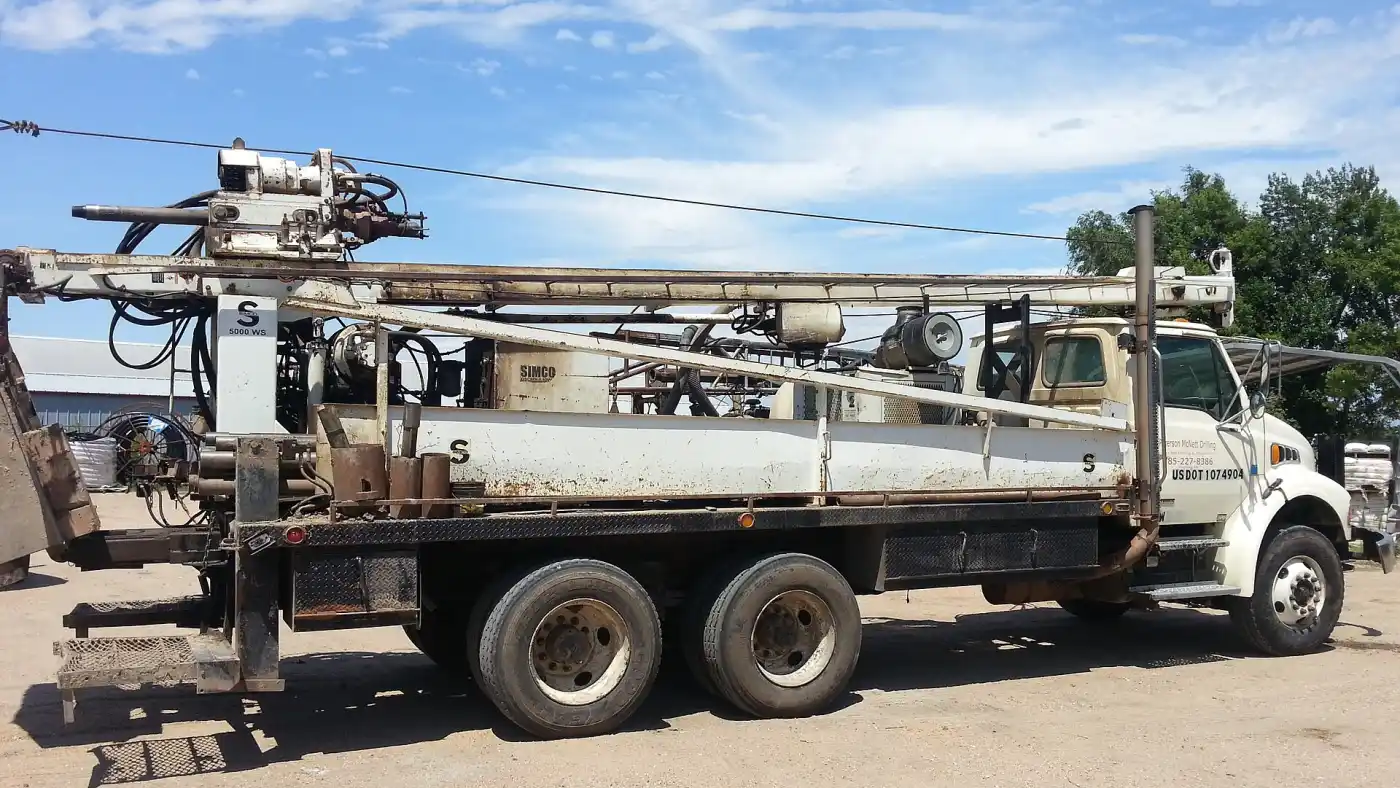
Two hundred and fifty metres is a long way in a built-up locality. A public bore, a Water Board source or a panchayat hand pump anywhere on your street will usually fall inside it, and most owners have never checked. The obligation does not depend on knowing the source is there.
The Act sets out the process in the same section. Section 10(2) requires the applicant to apply to the Authority in the prescribed manner and on payment of the prescribed fee, and Section 10(3) gives the Authority 45 days to approve or refuse, on the advice of a technical officer, based on the impact on public water sources. Forty-five days is not a formality you can start in the week the rig is booked.
Does an existing well have to be registered?
Yes, and this catches almost every plot that already has one. Section 8(2) of the Act states that owners of all wells — including those not fitted with power-driven pumps — and water bodies in the State shall register them with the Authority.
Read that as written. It is not limited to new wells, not limited to agricultural wells, and not limited to wells with a motor. An open well on a plot you have just bought, dug decades ago and long forgotten under a slab of stone, is a registrable well.
This matters at purchase as much as at construction. If you are still choosing a plot, add it to the diligence — our plot buying checklist for Hyderabad covers the documents; the well on site is a physical thing to ask about and to see registered before you take it on.
How far must a new well be from an existing one?
There is no single number in the Act. Section 13 authorises the Authority to issue directions specifying the distance for sinking wells from an existing well, and the depth for such sinking, in areas that are not overexploited. The distance is set by direction for the area, not fixed in the statute.
The practical consequence is that you cannot answer this from a website, including this one. You ask the Ground Water Department what direction applies to your locality, because the answer in an overexploited mandal is different from the answer in one that is not — and Hyderabad’s position, set out below, is not comfortable.
It also means a driller telling you “the rule is 200 feet” is quoting a rule of thumb, not a direction. Ask to see what he is relying on.
What are the penalties?
The Telangana Water, Land and Trees Act sets the penalty at Section 35(1) as a fine of not less than one thousand rupees, extending to five thousand rupees, for contravention, and Section 35(4) doubles the fine for a second or subsequent offence.
The fine itself is not what should govern your decision — on a house of this size it is noise. What matters is that an unpermitted well is an irregularity attached to your property, discoverable later, at exactly the moment when irregularities are least welcome: a sale, a loan, a dispute with a neighbour whose own well has failed. The cost of doing it correctly is an application and a wait. The cost of not doing it is open-ended.
How deep is the water in Hyderabad now?
Deeper than last year and falling fast. The South First reports Central Ground Water Board figures showing Hyderabad at 9.96 metres below ground level in June 2025 and 12.43 metres in June 2026 — a fall of 2.47 metres in twelve months, the most critical in the state.
Set beside that a second figure from the same report. The South First records the Telangana Groundwater Department’s assessment that Hyderabad is extracting 96 per cent of its annual available groundwater, which places the city in the “critical” category. The CGWB’s June 2026 assessment found levels deteriorating in 17 districts against improvement in 16.
| Reading | Figure | What it tells you |
|---|---|---|
| Hyderabad, June 2025 | 9.96 m below ground | the baseline |
| Hyderabad, June 2026 | 12.43 m below ground | after one year |
| Change | −2.47 m in 12 months | the steepest in Telangana |
| Extraction | 96 per cent of annual availability | “critical” category |
| State picture, June 2026 | 17 districts worse, 16 better | not a Hyderabad-only problem |
Figures above are as The South First reports them from the CGWB and the Telangana Groundwater Department. The number that should change your behaviour is the 96 per cent. A basin drawing almost everything it receives has no buffer left. In a weak monsoon it does not dip — it fails, and the failure arrives as a tanker bill rather than a headline.
Why “drill deeper” is the wrong answer
Below the weathered zone, Hyderabad is granite. Water in granite sits in fractures, not in the rock, so beyond a point extra depth adds cost without adding yield. A dry 600-foot bore and a dry 300-foot bore are equally dry; one simply cost twice as much.
This is the misunderstanding that drives the most expensive mistakes on site. In alluvial ground — much of north India — deeper generally does mean more water, because you are entering thicker saturated sediment. Hard-rock terrain does not behave that way. You are hunting fracture zones, and if you miss them, the metres below are solid rock holding nothing.
The consequence is that where you drill matters more than how deep you drill, and where is a question for someone reading the local geology rather than for the rig operator paid by the foot. That is a conflict of interest worth naming out loud before the work starts.
You may also already have relevant data. If you ran a soil test before construction, the boreholes logged where the weathered zone ended and the rock began on your plot. That is the single most useful piece of information for siting a well, and it is usually sitting unread in a report commissioned for the foundation.
Where the well sits decides where the sump, the pump room and the recharge pit can go. That is a plan decision, not a driller decision.
What a proper borewell job includes
Casing through the weathered zone, a sealed head, a yield test before the pump is chosen, and a written log of what was struck at what depth. Most quotations include the drilling and little else.
Six things separate a borewell that will still be serving the house in fifteen years from one that silts, collapses or contaminates:
- Casing pipe run to the full depth of that weathered layer. Stopping short lets loose material collapse into the bore. This is the commonest cause of a well that yielded well for a season and then went cloudy and dropped.
- A grouted, sealed head above ground. An open or ground-level head lets surface water — and whatever is on your driveway — run straight into the aquifer you drink from.
- A yield test before buying the pump. Pump selection follows the well’s actual delivery. Sized from optimism, a pump runs dry, burns out, and is replaced annually.
- A written driller’s log. Depth, strata, casing depth, where water was struck and at what yield. You will want this if the well fails, if you ever site a second one, and to size a recharge structure properly.
- Distance from the septic tank and the soak pit. This is a design decision on your own plot, and it is fixed at layout stage, not after the well is drilled.
- A recharge structure feeding the same aquifer. A well that only extracts is a well with a shortening life. This is the direct link to rainwater harvesting, and on a plot over 200 square metres that structure is a legal requirement anyway.
Where it belongs in the build sequence
Before the compound wall and the driveway, and after the layout is fixed. A rig needs access, and the well’s position has to respect the septic tank, the recharge pit and the future paving.
Drilled too early, with no layout agreed, the well ends up where the rig could reach and later sits under a car porch. Drilled too late, the rig cannot get in without breaking something. It belongs in one conversation with the other site services, which is where our stage-by-stage build sequence places it.
There is also a sequencing argument for drilling early in a different sense: if the plot has no water, that is something to learn before you have poured a foundation, not after. A dry bore does not stop the build — the city supply and a sump will run the house — but it changes the sump sizing, the plumbing and the budget, and those are cheaper to change on paper.
How we handle this at Simfy Homes
We read the soil investigation log before siting the well, not after, we fix the well, septic tank and recharge pit positions together on the layout so none of them compromises another, and we ask for the driller’s log in writing as a deliverable, not as a favour. Where a client wants a borewell, that pit is drawn alongside it, because on these plot sizes it is required and because a well without one is a depreciating asset.
We are not hydrogeologists and we do not pretend the outcome is predictable. What we can do is make sure the decision is taken with the information that already exists on your site. If you are planning a build, talk to our team before the layout is frozen.
When we are not the right fit
If the plan is to call a rig, drill as deep as the budget allows and hope, that is a common approach in this city and it does not need us. We would insist on reading the strata log, permitting the well properly and building the pit alongside it, and all three cost time before anything is drilled. If speed is the priority over the well still working in ten years, we are honestly not the right studio for that job.
Frequently asked questions
Do I need permission for a borewell on my own plot?
It depends on what is near it. Section 10(1) of the Telangana Water, Land and Trees Act 2002 prohibits sinking a well within 250 metres of a public drinking water source without permission. Separately, Section 8(2) requires owners of all wells to register them with the Authority, including wells with no power-driven pump.
How long does permission take?
Section 10(3) of the Act gives the Authority 45 days to approve or refuse the application, acting on the advice of a technical officer and considering the impact on public water sources. Plan for it well before the rig is booked.
What is the fine for drilling without permission?
The Telangana Water, Land and Trees Act sets the fine at Section 35(1) at not less than ₹1,000 and up to ₹5,000, and Section 35(4) doubles it for a second or subsequent offence. The larger exposure is not the fine but an unpermitted well attached to the property, which surfaces at a sale or a loan.
How deep should a borewell in Hyderabad be?
There is no correct number, because in hard-rock terrain yield comes from fracture zones, not from depth. What is known is that the water table itself is falling: The South First reports CGWB figures of 9.96 metres below ground in June 2025 and 12.43 metres a year later for Hyderabad, a fall of 2.47 metres. Site the well on the geology, not on a target depth.
My neighbour’s borewell went dry after mine was drilled. Is that connected?
It can be. Wells close together in one fracture system draw from a single limited storage, which is exactly why Section 13 allows the Authority to specify distances between wells for an area. The South First puts Hyderabad’s extraction at 96 per cent of annual availability, which leaves very little spare to share.
Is it worth drilling at all if the water table is falling?
Often yes, but paired with recharge rather than alone. A well that only extracts in a critical basin has a shortening life. On a plot over 200 square metres a rainwater harvesting structure is required in any case, so the sensible move is to build both and treat them as one system.
What should I get from the driller in writing?
A log: total depth, the strata passed through, the depth to which casing was set, the depth at which water was struck and the yield at that point. It is ordinary practice, it costs nothing, and without it you cannot size a pump properly, plan a recharge pit, or make an informed decision about a second well later.
One accountable team from the first sketch to handover, with the things that get buried photographed before they are covered.