


The problems you can see in a home are never the expensive ones. Bad tiles get swapped in a weekend. But the cement in your slab and the steel inside your columns are sealed under plaster forever — nobody can check them once the concrete is in. That is why the two most important choices in your whole build are made in the first few weeks, quietly, before anything looks like a house.
So when people ask which cement is best for house construction, they are really asking a bigger question: what goes into a home that is still solid in fifty years, and how do I make sure my builder actually uses it? This is a builder’s honest answer — the same materials we specify on our own sites, in plain words, plus how you can check yours are being used right even if you never visit the site.
- The short answer
- Which cement is best — OPC vs PPC, and grade
- Which cement for which part of the house
- Which steel is best — TMT grades and brands
- Sand, aggregate and water — the quiet materials
- Bricks and blocks — the walls around you
- The materials nobody sees (where homes really fail)
- How to check your builder is using them
- How to read a mill certificate and material bills
- A materials checklist, stage by stage
- House construction materials in Hyderabad
- Common questions
The short answer
That single line answers most of the search. The rest of this guide explains why, and — more importantly — how you make sure the bags and bundles that reach your site are the ones you were promised.
Which cement is best — OPC vs PPC, and grade
There are dozens of cement types on paper. For a home, only two matter: OPC (Ordinary Portland Cement) and PPC (Portland Pozzolana Cement). Both are good. They just behave differently.
| Cement | How it behaves | Best for |
|---|---|---|
| OPC 53-grade | Gains strength fast, high early strength, needs careful curing or it cracks | Structural concrete — columns, beams, slabs, foundations |
| OPC 43-grade | Slightly slower, a little more forgiving | Masonry, plaster, non-structural work |
| PPC (fly-ash blend) | Gains strength slower but keeps gaining for months, denser and more crack-resistant over time, better against water | Whole-house use, especially in humid or coastal areas |
So which cement grade is best for house construction? For the parts that hold the house up, 53-grade OPC or a quality PPC. Many careful builders actually prefer PPC for the full structure in humid cities because the finished concrete ends up denser and less prone to hairline cracks — as long as it is cured properly, which takes patience most rushed sites do not have.
On brand: UltraTech, ACC, Ambuja, Dalmia, Zuari and other established names all make cement that meets the same Bureau of Indian Standards (BIS) numbers. A genuine bag from any of them is fine. What ruins concrete is not the logo — it is old stock that has absorbed moisture, wrong water ratio, or curing cut short to save days. Chasing the “best brand” while ignoring those three things is looking at the wrong problem.
Which cement for which part of the house
You do not use one bag for everything. A good site uses the right material in the right place.
| Part of the house | What we use | Why |
|---|---|---|
| Foundation, columns, beams, roof slab | 53-grade OPC or quality PPC, design mix concrete | These carry the load — strength and density matter most here |
| Brick / block walls | 43-grade OPC or PPC mortar | Walls do not need the highest grade; over-strong mortar can even crack bricks |
| Internal plaster | 43-grade or PPC | A smoother, more workable finish that resists shrinkage cracks |
| Bathrooms, terraces, water tanks | PPC with the correct waterproofing method | Denser concrete plus the right sequence keeps water out for years |
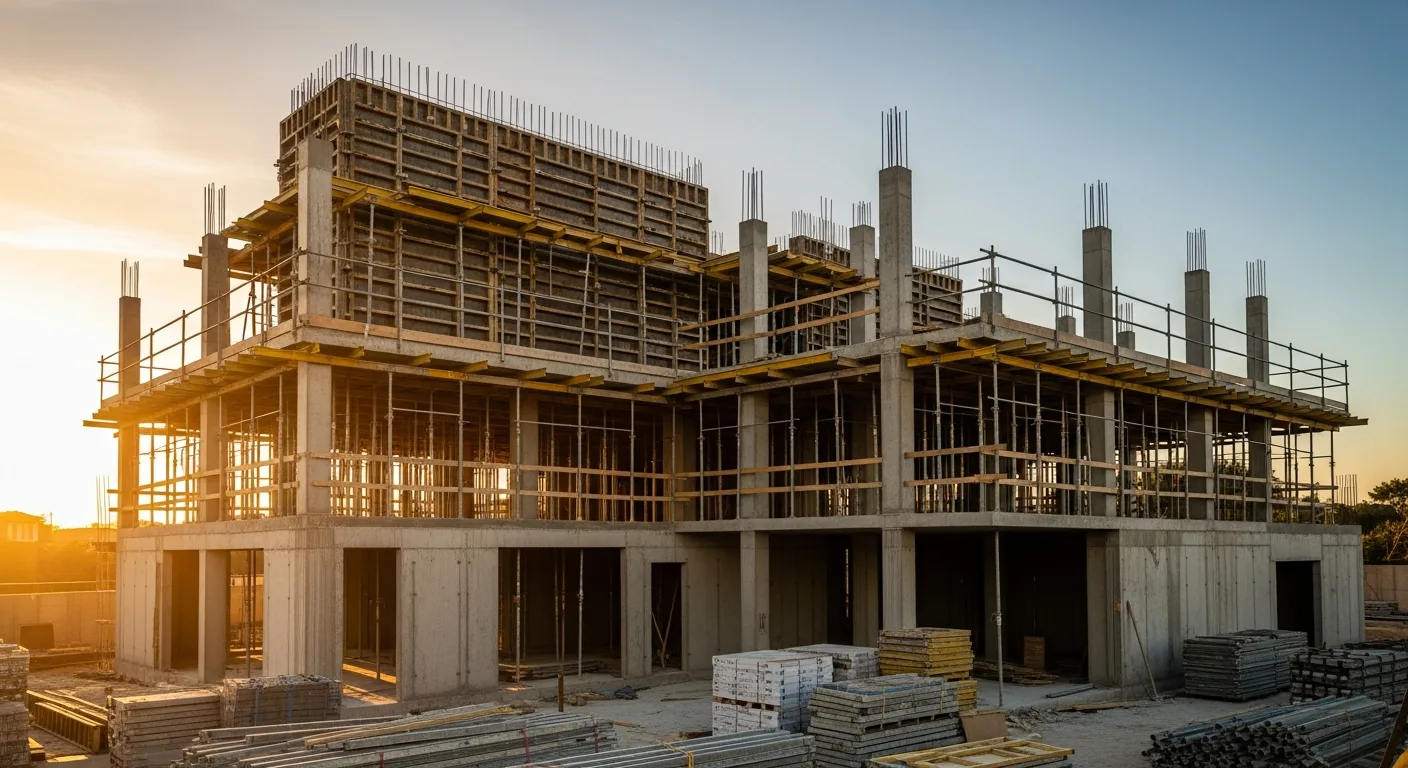
Which steel is best — TMT grades and brands
The other half of your structure is the steel hidden inside the concrete. When people ask which steel is best for house construction, they usually mean two questions: which grade, and which brand.
Use TMT bars (Thermo-Mechanically Treated). For grade, Fe500D is the right choice for most homes. The number is the strength; the “D” means higher ductility — it bends before it breaks, which is exactly what you want in a region that can see tremors. Fe550D is stronger and stiffer and has its place in heavier structures, but for a normal house Fe500D gives the better balance of strength and safe flexibility.
| TMT grade | What it means | Use |
|---|---|---|
| Fe500D | Strong and ductile — bends before failing | Recommended for homes and villas, especially in seismic zones |
| Fe550 / Fe550D | Stronger, stiffer, less give | Heavier or specific structural designs, on an engineer’s call |
| Fe415 | Older, softer grade | Largely outdated for new structural work |
On brand — Tata Tiscon, JSW, Jindal Panther, Vizag and other primary producers all make genuine, BIS-marked Fe500D. Any of them is trustworthy. The real danger is not choosing between Tata and Jindal; it is re-rolled steel — bars melted down from scrap by small mills, stamped to look branded, sold cheap. It looks the same on delivery and fails under load. That is why the rib pattern, the mill mark rolled into the bar, and the mill test certificate matter more than the name on the invoice.
Sand, aggregate and water — the quiet materials
Cement and steel get all the attention, but concrete is mostly sand, aggregate and water — and each quietly decides how strong and durable the result is. Sand should be clean and free of silt and salt; dirty or salty sand weakens concrete and rusts the steel from inside, which is why washed river sand or good manufactured sand (M-sand) is used, not whatever is cheapest at the pit. Aggregate — the crushed stone — must be clean, hard and well-graded; dusty or weak stone gives weak concrete. And water matters more than people expect: it should be clean and potable, because dirty or salty water carries the same rust and weakness into the mix. None of this shows up in a brochure, and all of it is where a rushed site quietly saves money at your home’s expense.
Bricks and blocks — the walls around you
Walls carry less drama than the frame, but they decide how your home feels, insulates and cracks. Which bricks are good for house construction depends on what you want the wall to do.
Traditional red clay bricks are strong and breathable but vary in quality and need good-quality soil. Fly-ash bricks are more uniform and eco-friendlier. AAC blocks (autoclaved aerated concrete) are lightweight, insulate against heat well — a real advantage in a hot city — and speed up work, though they need the correct adhesive and fixings rather than ordinary mortar. There is no single winner; a good builder picks by wall type, climate and finish, and tells you why.
The materials nobody sees (where homes really fail)
Here is the part the cement-brand articles skip, because it does not sell bags. Most homes that fail early do not fail because of the cement brand. They fail because of the small, invisible things done in a hurry:
- Curing cut short. Concrete needs to stay wet for the full 14 days, not 7. Skipping this is the most common reason slabs crack — and it costs nothing but patience.
- Waterproofing at the wrong stage. In bathrooms, terraces and sunken slabs, waterproofing has to happen in the right sequence. Done late or skipped, it is the number-one cause of leaks in Hyderabad homes.
- Wrong water-cement ratio. Extra water makes concrete easier to pour and permanently weaker. You cannot see it after the pour.
- No cover blocks. Steel needs a clean margin of concrete around it so it never rusts. Bars resting against the shuttering will rust within years and swell, causing cracks from inside.
None of these show up in a brochure or a bag. All of them are decided by the discipline of the team, not the material. This is why we photograph steel and cover blocks before every pour — because once the concrete is in, nobody can check any of it again.
How to check your builder is using them
You should not have to take anyone’s word for what is inside your walls. Whether you are on site every day or managing the build from another city, these are the honest checks that keep everyone straight — and any good builder will welcome them.
- Cement: see the bags. Check the grade, the BIS mark, and the manufacturing date — cement older than about three months, or hardened lumps, should be rejected.
- Steel: ask for the mill test certificate for each lot, and look for the mill mark rolled into the bar itself. This is how you rule out re-rolled steel.
- Concrete: for structural pours, ask for cube tests — small samples cast from your own concrete and crushed in a lab at 7 and 28 days to prove the strength. This is standard, cheap, and the single best proof your concrete is what was promised.
- Before every pour: ask for photos of the steel, spacing and cover blocks. Two minutes on a phone; a permanent record you can never recreate later.
- Curing: ask how many days each slab was kept wet. The honest answer is 14. Anything less is a shortcut.
If a builder hesitates at any of these, that hesitation is your answer. Transparency about materials is not a favour — it is the baseline, and it is exactly what separates a genuine construction company in Hyderabad from a cheaper crew.
How to read a mill certificate and material bills
Two simple documents tell you most of what you need, if you know what to look for. A mill test certificate (MTC) comes with each lot of steel and lists the grade (you want Fe500D), the batch number, and the chemical and strength test results — match the batch number on the certificate to the tag on the bundle delivered to your site, so you know the paper describes the actual steel. The material bills for cement and steel should name the brand, grade and quantity; keep them, because they are your record that what was ordered is what arrived. You do not need to understand every number — you need the grade to be right, the batch to match, and the documents to exist at all. A builder who cannot produce them is telling you something.
A materials checklist, stage by stage
Materials arrive and are used at different points as a home rises. Here is where the checks belong.
- Before foundation: a soil test to design the foundation for your ground, not a copy from the next plot.
- Steel delivery: mill mark on the bar, mill test certificate, batch matched to the tag.
- Every concrete pour: right cement grade and fresh stock, clean sand, aggregate and water, cover blocks in place, cube tests taken, photos before the pour.
- Curing: slabs kept wet the full 14 days.
- Masonry & plaster: the chosen brick or block, correct mortar grade, no over-strong mix.
- Wet areas: waterproofing at the right stage, before tiling.
House construction materials in Hyderabad
Materials are national — the same cement and steel brands sell across India — but how you use them is local. In parts of Hyderabad the soil and rock change street to street, so a real soil test before the foundation is designed matters more than any bag of cement; a foundation copied from the next plot is a gamble. The city’s humid stretches reward denser PPC concrete and careful curing, and its hard monsoon makes clean materials and proper waterproofing non-negotiable. Wall choice is where material and comfort meet: AAC and fly ash blocks transfer less heat than solid clay brick, which is why they matter to eco friendly house construction in Hyderabad as much as to cost. When you plan house construction in Hyderabad, the right material list depends on your plot, your soil and the climate — which is exactly the judgement a design-and-build team that plans and builds your home under one roof is there to make, rather than buying whatever is cheapest that week. See how it fits into the wider house construction process.
Want to see how a home should actually be built?
We plan, design and build under one accountable team — with the material checks, photos and honest timelines built in from day one.
Common questions
Which cement is best for house construction?
For the structure — foundation, columns, beams and slab — 53-grade OPC or a good PPC from a BIS-marked brand. For plaster and masonry, 43-grade or PPC. Grade, freshness and curing decide the result far more than which brand you buy.
Which is better, OPC or PPC?
Both are good. OPC 53 gains strength faster and suits structural work; PPC gains strength more slowly but keeps gaining, ends up denser and more crack-resistant, and handles humidity and water better. Many builders use PPC for the whole house in humid cities, provided it is cured properly.
Which steel is best for house construction?
Fe500D TMT bars for most homes — strong yet ductile, which is safer in areas that can see tremors. Tata, JSW, Jindal, Vizag and other primary producers are all genuine; the real risk is cheap re-rolled steel, which you rule out with the mill mark and mill test certificate.
Which sand is best for house construction?
Clean sand free of silt and salt — washed river sand or good manufactured sand (M-sand). Dirty or salty sand weakens concrete and rusts the steel inside it, so the source matters more than the price. The same goes for clean aggregate and clean, potable mixing water.
Which TMT bar is best, Tata or Jindal?
Both are trustworthy primary producers making genuine Fe500D. The choice between them rarely matters. What matters is that the bar carries a real mill mark and comes with a mill test certificate — that is what separates genuine steel from re-rolled scrap.
How do I check material quality if I cannot visit the site?
Ask for a fixed record: cement bag photos with grade and date, steel mill test certificates with batch numbers matched to the delivery, cube-test results at 7 and 28 days, and pre-pour photos of the steel and cover blocks. A builder who sends these without being chased is showing you the home is being built the way it was promised.
Building in Hyderabad or Goa?
Talk to our team about your plot or plan — no pressure, just honest advice on how your home should be built.
Written by the Simfy Homes team. We design and build homes in Hyderabad and Goa under one accountable team. See our guides to waterproofing a home, why walls crack, and turnkey home construction.