

- Can you build a home in Hyderabad while living abroad?
- What an NRI actually worries about — and how each is removed
- Choosing a builder you can’t meet in person
- The paperwork: power of attorney, approvals and NRI accounts
- How progress is documented so you can watch from anywhere
- Design-and-build vs coordinating vendors from abroad
- The eight moments worth a live video call
- Payment clauses that protect a remote owner
- When you should not build remotely
- How Simfy Homes builds for remote and NRI owners
- Frequently asked questions
Building a home in Hyderabad from another country — without the 2am worry about where your money went.
You have the plot, or you are about to buy one. You have the savings of years, sitting ready. And you are eight thousand kilometres away, in a different timezone, unable to drive to the site on a Sunday to see whether the steel that went into your foundation was the steel you paid for. That gap — between your money and your eyes — is the whole problem of building from abroad. It is also completely solvable.
This is a plain guide for NRIs and out-of-city owners building a home in Hyderabad: what to actually worry about, how a good builder removes each worry, the paperwork you cannot skip, and how to choose a firm you may never meet in person.
In short: An NRI can build a home in Hyderabad remotely and safely, but only if it is set up properly: one team that both designs and builds, under a single written contract, a specification that names every material before work starts, documented photo-and-video progress on a fixed schedule, and a stage-wise payment plan tied to work actually done. The distance is managed with paperwork and proof, not trust in a voice on a call.
Can you build a home in Hyderabad while living abroad?
Yes — and many of the finest homes in the city are built exactly this way. The distance is not the risk; the lack of structure is. With one accountable team, a written specification, documented progress and stage-linked payments, a remote build is often better controlled than one where the owner drops in occasionally and assumes the rest is fine.
Thousands of Hyderabad homes are built every year for owners in the Gulf, the US, the UK, Singapore and Australia. The ones that go well are not the ones where the owner flew down most often. They are the ones set up so the owner did not need to. When responsibility sits with one team, the specification is in writing, and every stage is photographed before it is covered, being far away stops being a disadvantage — because the same discipline that protects a remote owner protects a local one. What ruins remote builds is the opposite: a chain of separate vendors, a vague quote, and progress reported over the phone with nothing to check it against.
What an NRI actually worries about — and how each is removed
The real fears are specific: paying for materials you never see, quality hidden under plaster, endless delays, and being quietly overcharged. Each has a concrete fix — a named specification, photographed stage checks, an honest timeline in the contract, and payments released only against completed stages.
Say the fear out loud and it becomes a checklist. Here is what worries a remote owner, and what a properly run build does about each.
| The worry | How a good build removes it |
|---|---|
| “Am I paying for materials that never arrive?” | A specification sheet names the brand and grade of every material; deliveries are photographed against it |
| “How do I know the structure is sound?” | Reinforcement is checked and photographed before every pour — once concrete is in, nobody can check it again |
| “Will it drag on for years?” | An honest stage-wise timeline in the contract, with progress you can hold them to |
| “Am I being overcharged because I’m away?” | One fixed price against one written scope; payments released only against completed stages |
| “Who do I even call when something is wrong?” | One point of contact and one team, answerable from first drawing to handover |
Choosing a builder you can’t meet in person
When you cannot walk into an office and read a person across a table, you have to judge on evidence instead of instinct. The good news is that evidence is more reliable than instinct anyway.
- Ask for finished homes you can verify — and, where possible, a video call with an owner who built remotely like you.
- Ask for a written specification naming the brand and grade of every material, before you pay anything.
- Confirm design and build sit under one team, not a designer who hands off to a separate contractor.
- Ask exactly how progress will be documented — photos, video, and how often.
- Insist on a stage-wise payment plan tied to completed work, never large advances against promises.
- Walk away from a firm that pressures you to decide quickly, or whose price changes each call.
The paperwork: power of attorney, approvals and NRI accounts
A remote build needs a little groundwork: usually a registered power of attorney so someone you trust can sign locally, a sanctioned plan from GHMC or HMDA, and payments routed through your NRE or NRO account. A good builder guides you through the construction approvals; a lawyer and your bank handle the POA and money side.
You do not have to fly down for everything, but a few things need doing properly. Many NRIs give a registered power of attorney to a parent, sibling or trusted person in India, so approvals and local formalities can be signed without you present — this is worth getting drafted carefully by a lawyer, limited to what is needed. The build itself needs a sanctioned building plan from GHMC or HMDA depending on the plot, correct setbacks and zoning, and any gated-community NOCs — an accountable builder handles these so you are not chasing offices from abroad. Payments are typically routed through your NRE or NRO account, and larger movements have their own rules, so confirm the current position with your bank. None of this is exotic; it is just a sequence, and it should be mapped for you before work starts.
This section is general information, not legal or financial advice — confirm POA, tax and repatriation specifics with a qualified lawyer and your bank.
How progress is documented so you can watch from anywhere
Documentation is what replaces standing on the site. Regular dated photos and short videos of each stage, the specification checked off as materials arrive, and a single point of contact who answers at your hour turn a remote build from an act of faith into something you can actually watch and question.
The difference between a remote build you worry about and one you can trust is simply how much you can see. Ask for dated photographs and short videos at each stage — foundation and reinforcement before the pour, slab, walls, waterproofing, finishing — shared on a schedule, not only when you chase. Ask that the specification be ticked off as materials land on site, so “we used a good brand” becomes a photograph of the actual brand. And insist on one person who knows your project and answers your call across the timezone. When the work is visible, questions get answered before they become disputes, and you sleep better in another country than many owners do in the same city.
Design-and-build vs coordinating vendors from abroad
From another country, coordinating an architect, a contractor and a chain of vendors yourself is close to impossible — the waits and blame land on you at the worst hours. A single design-and-build team removes the coordination entirely: one contract, one schedule, one accountable party. For a remote owner it is less a preference than a necessity.
A local owner who enjoys running projects can just about hold a chain of separate vendors together. From eight timezones away, you cannot — and every gap between an architect and a contractor becomes a phone call at 3am and a decision made without you. A design-and-build team in Hyderabad collapses that chain into one line of responsibility: the people who drew your home build it, to one specification and one timeline, and answer for the result. That is why turnkey and design-and-build exist, and why they suit remote owners best of all. If you want the full picture of how that model works end to end, our guide to turnkey home construction in Hyderabad goes deeper.
The eight moments worth a live video call
A build that runs a year or more has only a handful of moments where something is about to be covered up for good. Those are the ones worth being on a live call for — not a photograph sent afterwards, but a call where you can ask the person holding the camera to turn it, hold it still, or move closer. Eight moments across a whole project is the entire discipline.
A recorded photograph proves something existed. A live call lets you ask a question while the answer can still change something. These are the points where a remote owner should insist on one, from any builder:
- The soil test read against the foundation design — before the design is finalised, not after. Ask to hear what the report actually said, and how the foundation responds to it.
- Excavation and foundation, before concrete. Depth, bearing and the state of the ground are visible now and never again.
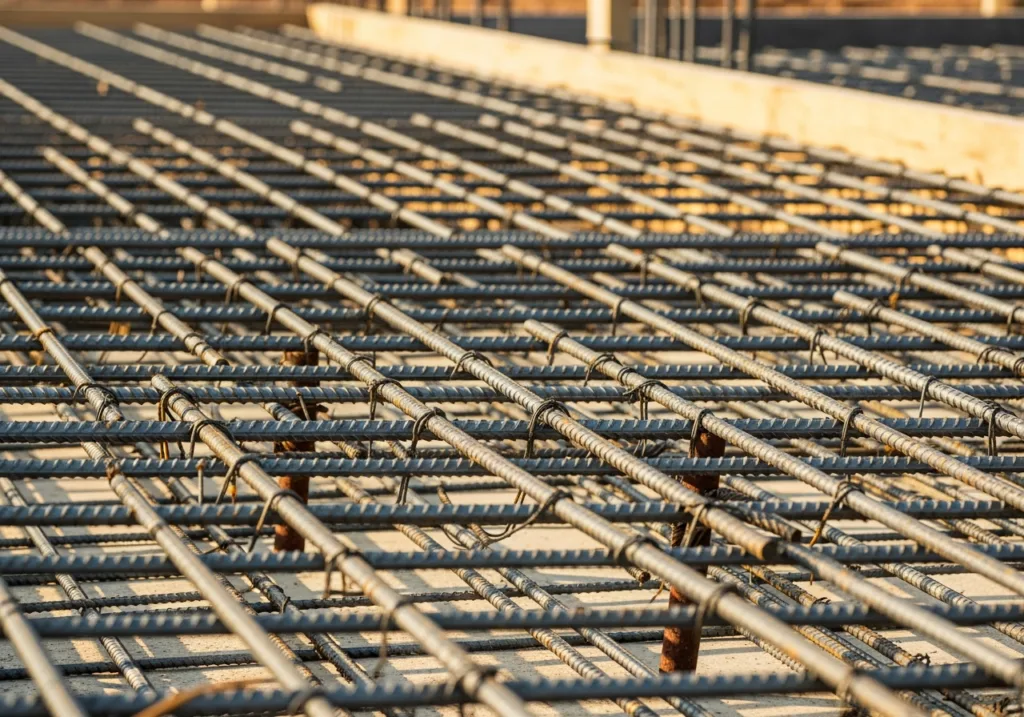
- Column and slab reinforcement, tied and in place, before every pour. Bar sizes, spacing, laps and the cover blocks under the steel. Once concrete goes in, nobody can check any of it, including a court.
- The pour itself, and the date curing started. Ask what grade arrived, whether water was added on site, and when curing began — then ask for the date to be written down.
- Brickwork and lintel level, before plaster. Room sizes, opening positions and lintels are cheap to correct today and expensive next month.
- Plumbing and electrical conduit in the wall, before plaster covers it. This is your only chance to see where every point actually sits against the drawing.
- Waterproofing in bathrooms, terrace and sunken slabs, before screed. Watch the upstands and the corners, which is where it is usually skipped.
- Water and drainage test, before flooring. Filled, held, and checked for a drop — not tested after the tiles are down.
Put these eight into the agreement as scheduled checks with notice, so they are booked rather than requested as a favour. A builder who cannot make eight moments visible to an owner living abroad is telling you something about how the rest of the work will be run. If you want the ground-level version of what is being looked at in each call, our guide on how to check construction quality, and what can still be corrected later goes through it stage by stage.
Payment clauses that protect a remote owner
Most disputes on a remote build are payment disputes wearing a different coat. The fix is structural and it goes into the agreement before anything starts: money is released against a completed and documented stage, never against a calendar date. Distance makes a weak clause much more expensive, because you cannot walk to the site and see what a date has actually bought.
A construction agreement is a private contract, so you are free to write these terms in. Most owners simply accept the builder’s format. Reading it once, properly, is the highest-value hour in the whole project, and it costs nothing.
| Weak clause | What it lets happen | Stronger clause |
|---|---|---|
| “Payment due on a fixed date” | Money moves whether or not the work did | Payment released on completion of a named stage, evidenced by dated photographs and a site engineer’s sign-off |
| “Advance as mutually agreed” | Open-ended pressure for more money at every stage | A fixed advance, named in the contract, with nothing further released until the first stage closes |
| “Materials as per standard” | Substitution with no breach of contract | Brand and grade named per item, with any change requiring your written approval before it is bought |
| “Balance on completion” | No leverage left when the snag list appears | A retention held for an agreed defect-liability period after handover |
| “All inclusive”, with no list | Compound wall, gate, landscaping, sump, tank, service connection and statutory deposits arrive later as extras | A written exclusions list, in full, agreed before signing |
| No named contact | The project stalls because one person is unreachable across a time-zone gap | A named single point of contact and a named deputy, both written into the agreement |

None of this is adversarial. A builder who works to a written scope and a documented stage-payment schedule is usually relieved to have one, because it ends the argument about what was promised. The clause to be wary of is the vague one, and vagueness costs the person who is furthest from the site.
When you should not build remotely
There are three situations where building from abroad should wait. An unresolved title, boundary or encroachment question on the plot. A budget with no contingency at all. And nobody you trust who can reach the site within a few hours. None of these means you should not build — it means the build should start after they are settled, not before.
Take them one at a time, because each fails in its own way.
Unresolved paper. If the title has a question mark, or the boundary is disputed, or something is encroaching, do not start a build to force the issue. Construction turns a paper problem into a physical one, and a stop-work notice reaches a site far faster than you can reach a lawyer from another country. Fix the paper first.
No contingency. Remote builds absorb more change requests, not fewer, because every clarification costs a day and every day tempts a decision that avoids waiting. A budget with nothing spare turns each of those into a compromise on specification, and specification is where the permanent decisions live.
Nobody who can reach the site. A leak, a labour issue or a notice on the gate does not wait for a video call across time zones. This does not have to be family. It can be a professional you appoint and pay. It does have to be somebody with the authority to act on your behalf and the willingness to actually go.
How Simfy Homes builds for remote and NRI owners
We design and build under one team, fix the specification in writing before we start, photograph the work that gets covered up, and share documented progress on a schedule — so a home you are building from abroad is one you can actually watch. One point of contact stays with you from first drawing to the day you get the keys.
Remote and NRI owners are a large part of who we build for, and everything about the way we work is built to close the distance. The specification is written and approved before work begins, so the quote means something. The reinforcement is checked and photographed before each pour; slabs are cured the time they need; waterproofing goes in at the right stage — and all of it is recorded, not just reported. You get one accountable team across design, structure and finishing, one honest timeline, and one person who answers your call at your hour. We build across Hyderabad and Goa, and you can see our finished homes or read how we work before you ever commit. If you are building the whole home, our construction in Hyderabad and house construction pages show the service in full.
Have a plot in Hyderabad and want one accountable team to build while you watch from anywhere? Let’s talk it through, on your timezone.
Frequently asked questions
Can an NRI build a house in Hyderabad without being present?
Yes. With a registered power of attorney for local signatures, one accountable design-and-build team, a written specification and documented photo-and-video progress, an NRI can build remotely and safely. Many owners in the Gulf, US, UK and Singapore build this way without living in India during the project.
How do I make sure I am not cheated while building from abroad?
Structure removes the risk, not trust. Insist on a written specification naming every material, stage-wise payments released only against completed work, reinforcement photographed before each pour, and one accountable team. Ask to speak to an owner who built remotely. Evidence you can check beats any assurance on a call.
Do I need a power of attorney to build a home in Hyderabad as an NRI?
Usually yes, for convenience — a registered POA lets a trusted person in India sign approvals and local formalities without you flying down. Keep it limited to what is needed and have a lawyer draft it. Confirm the specifics with a qualified professional, as this is general information, not legal advice.
How will I see progress on my home from another country?
Ask for dated photos and short videos at each stage — foundation, reinforcement before the pour, slab, walls, waterproofing, finishing — shared on a schedule, plus the specification ticked off as materials arrive, and one point of contact who answers across your timezone. Visible progress is what makes a remote build safe.
Which account should an NRI use to pay for home construction in India?
Payments are generally routed through your NRE or NRO account, and larger movements have their own rules. The construction side — approvals, specification, stage payments — a good builder maps for you; the banking and repatriation side, confirm with your bank, as this is general information rather than financial advice.