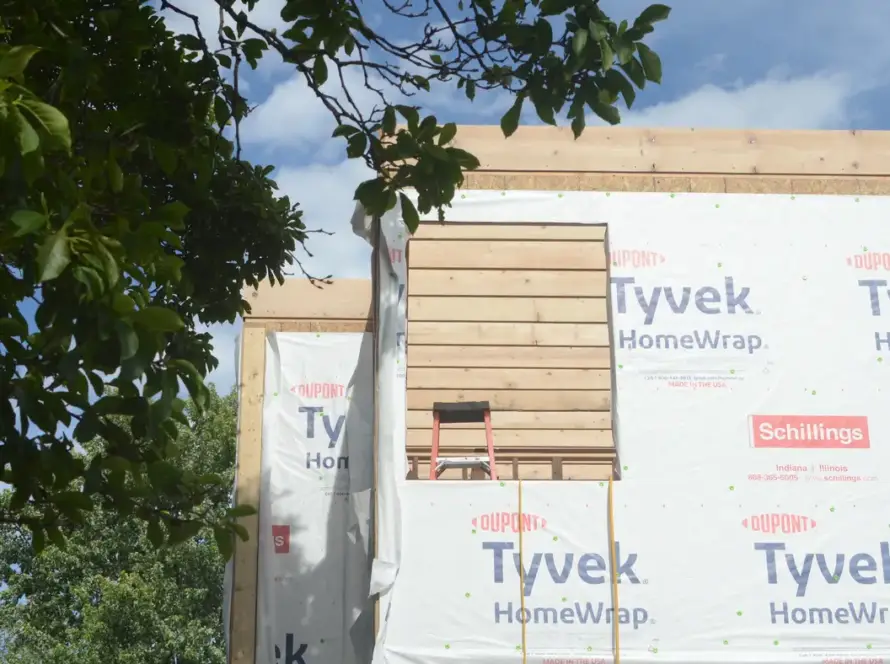
- Why house construction actually runs late
- What the law gives you, honestly
- The delay penalty clause that actually bites
- Your payment schedule is your real programme
- The days you cannot buy back
- Hyderabad and Goa: the local realities that move dates
- What to do when the builder has already stopped
- How we hold a date
- When we are not the right fit
A house rarely stops on the day it stops. It stops three months earlier, on the day someone agrees to pay for work that has not been done yet. Here is how to avoid construction delays on a private build in Hyderabad or Goa: what really causes them, what the law does and does not give you, and the checks that keep a programme honest.
A man wrote on an Indian legal forum that his contractor had stopped work for a year. He had already borrowed from the bank and handed the money over. He was paying EMI on a house he could not live in. He was not asking how to sue. He was asking how this had happened to him.
It happens the same way almost every time, and the answer is not better Gantt charts. It is three things: keeping money behind the work instead of ahead of it, writing a contract that costs the builder something when he is late, and knowing which days are fixed by engineering and cannot be squeezed no matter who shouts. This is for someone building on their own plot with their own contractor, not someone buying a flat. The two look similar and are legally very different, and that difference is where most people get hurt.
Why house construction actually runs late
Most delays trace back to one of three causes: money paid ahead of work completed, decisions the owner has not made yet, and a schedule that never had any spare time built into it. Weather and labour shortages get the blame, but they are usually the trigger, not the reason. A healthy site absorbs rain. A stretched one collapses.

Look at what people describe when they complain. One homeowner had paid roughly 90 percent of the contract value with only half the work done, and the contractor was already asking for more. Another watched work stop at 80 percent, followed by a demand for extra money because material rates had moved. In both cases the contractor still had the house and the owner no longer had leverage. That is not bad luck. That is a payment schedule that ran ahead of a work schedule, and it is the most common failure on private builds in India.
The second cause is quieter. Tile selection, bathroom layouts, kitchen electrical points, the staircase railing. Each looks small. Each blocks a trade. A mason cannot chase walls for conduits nobody has drawn. Reading through the real stages of a house construction programme makes it obvious how early those decisions need to be locked if you want to avoid construction delays later.
What the law gives you, honestly
RERA protects buyers of registered projects, not people building on their own plot. If you have appointed a contractor to build your own house, there is no promoter and no allottee, so Section 18 does not apply to you. Your protection is the contract you signed, plus the Indian Contract Act and consumer law.
This matters because a lot of advice online blurs the two. Section 18(1) of the Real Estate (Regulation and Development) Act, 2016 says that if a promoter fails to complete or is unable to give possession by the date specified in the agreement for sale, the allottee may withdraw and demand the amount back with interest, and the proviso adds that an allottee who does not want to withdraw “shall be paid, by the promoter, interest for every month of delay, till the handing over of the possession.” That is a strong remedy. It is also written for a project sold to allottees.
Section 3(2)(a) of the same Act narrows it further. Registration is not required where the land proposed to be developed “does not exceed five hundred square meters or the number of apartments proposed to be developed does not exceed eight.” Most single-family plots in Jubilee Hills, Kokapet or Assagao sit under that line anyway.
What does govern you is your agreement. Section 74 of the Indian Contract Act, 1872 is blunt about how a penalty clause works: where a sum is named in the contract for breach, the injured party is entitled “whether or not actual damage or loss is proved to have been caused thereby, to receive from the party who has broken the contract reasonable compensation not exceeding the amount so named.” Read that twice. The number you write in the contract becomes your ceiling, not your floor. Write it too low and you have capped your own claim.
Interest is worth pinning down in writing too. For registered projects the Telangana State Real Estate (Regulation and Development) Rules, 2017 fix it at the “highest Marginal Cost of Lending Rate of State Bank of India plus two per cent.” You are not bound by that, but it is a defensible benchmark for a private agreement.
If the contractor simply stops, Section 69 of the Consumer Protection Act, 2019 requires a complaint to be filed “within two years from the date on which the cause of action has arisen.” The jurisdiction rules notified in 2021 place complaints up to ₹50 lakh with the District Commission, above ₹50 lakh and up to ₹2 crore with the State Commission, and above ₹2 crore with the National Commission. For a house in our range that usually means the State Commission. People lose months filing in the wrong forum.
This is general information, not legal advice. Have a lawyer read your actual contract before you sign it and again before you act on it.
The delay penalty clause that actually bites
A workable delay clause names a completion date, a daily or weekly sum, a cap, a defined list of events that extend time, and a written procedure for claiming that extension. Vague clauses fail. So do clauses with no extension mechanism, because a court reads them as unreasonable and reduces them.
Most private building agreements in India carry a line like “the work shall be completed within 14 months.” Nothing follows. No sum, no cap, no process. With no sum named, you are back to proving actual loss, which is slow and expensive. The clause did nothing.
A clause that works is boring and specific. It fixes the date. It names an amount per week of delay. It caps the total, often at a small percentage of the contract value, because a cap makes the number look reasonable rather than punitive. It lists what genuinely extends time: a bandh, an unusually heavy monsoon week, a statutory approval outside the contractor’s control, a change you asked for. And it says the contractor must claim that extension in writing within a set number of days, or lose it.
Add the mirror clause too. If you delay a decision or a payment, the contractor gets time. A one-sided contract is one the other side stops respecting on the first bad week. When people ask us how to judge a construction company before signing, we point them at the draft agreement first: read the delay clause and see whether it cuts both ways.
Your payment schedule is your real programme
Link every payment to a completed, photographed stage rather than a calendar date or a percentage the contractor states. Keep the money slightly behind the work at all times. A builder who is 15 percent underpaid finishes. A builder who is 15 percent overpaid negotiates.
The standard advice on this runs to five headings: plan properly, appoint a reliable contractor, use good materials, monitor progress, manage risk. None of it is wrong. None of it is the mechanism either, because none of it touches the order in which money leaves your account.
The mechanism is leverage. On the day you have paid 90 percent for 50 percent of a house, you have nothing left to withhold, and the contractor has every reason to move his crew to the site where he is still owed money. Nobody plans this. It happens through small kindnesses: an advance for a steel booking, an early release because the cement rate is rising, a payment made on a Friday because the labour needs paying.
The fix is unglamorous. Tie each release to a physical event that can be seen and photographed: footings cast and cured, plinth beam complete, first slab cast, brickwork to lintel level, internal plaster complete, first coat of paint. Retain a final slice until the defects list is closed. Then photograph the site at the same three points every week from the same standing positions. Twelve months later, when there is an argument about when a stage was actually finished, that folder is worth more than anyone’s memory. It is also why a properly run turnkey home construction arrangement is easier to police than a labour-rate contract with six separate agencies.
The days you cannot buy back
Some durations are set by concrete chemistry, not by effort. IS 456:2000 requires exposed concrete to be kept continuously moist for at least seven days with ordinary Portland cement, and fourteen days where blended cements or mineral admixtures are used. No amount of pressure shortens that without weakening the structure.
A contractor under pressure will find time somewhere, and the easiest place to find it is curing and formwork, because nobody can see what was skipped once the props are down and the plaster is on.
IS 456:2000 also sets the stripping times. Vertical formwork to columns, walls and beam sides can come off in roughly 16 to 24 hours. Soffit formwork to slabs, with props left refixed, comes off at around 7 days. Beam soffits, with props refixed, at around 14 days. Put those figures in the programme as fixed blocks and a lot of arguments disappear before they start.
| Fixed duration | What IS 456:2000 sets | What gets cut when a site is behind | What it costs you later |
|---|---|---|---|
| Curing, ordinary Portland cement | Continuously moist at least 7 days | Stopped at 3 to 4 days once the surface looks dry | Lower strength, crazing, shrinkage cracks in plaster |
| Curing, blended cement or admixtures | Extended to 14 days | Treated as plain OPC and stopped at a week | Strength gain never made up; durability cut for the life of the slab |
| Vertical formwork, columns and beam sides | Roughly 16 to 24 hours | Stripped the same evening to reuse shuttering | Edge damage, honeycombing, patches hidden under plaster |
| Slab soffit formwork | Around 7 days, props refixed | Props removed entirely to free the floor below | Deflection locked in, uneven floors, doors that never sit true |
| Beam soffit formwork | Around 14 days, props refixed | Struck with the slab shuttering in one go | Sagging in long spans, cracks at beam-column junctions |
These days are not float. They are the floor. If the programme carries no slack anywhere else, curing is the only slack the site can find, and it will take it.
Delay is the most common fear on a build, and payment sequencing is the least discussed cause.
Hyderabad and Goa: the local realities that move dates
In Goa the monsoon is not a risk to manage, it is a season to plan around. An IMD study published in MAUSAM found Goa receives about 3,045 mm of its roughly 3,300 mm annual rainfall during June to September, close to 90 percent of the year’s rain in four months. Hyderabad gets far less, but its own rhythm still bends the programme.
The India Meteorological Department notes the southwest monsoon normally sets in over Kerala around 1 June and covers the country by mid-July. For a Goa site, the window for excavation, foundations and anything involving open earth is effectively October to May. Casting a raft in July is not brave, it is expensive. What can run through the monsoon is internal work: block walls under a completed slab, conduiting, carpentry in a covered area, joinery in a workshop.
Goa adds a second constraint that has nothing to do with the calendar. Table 3 of IS 456:2000 classifies concrete exposed to a coastal environment as severe exposure, and surfaces exposed to sea water spray as very severe. Table 5 then requires severe exposure concrete to be at least grade M30, with a minimum cement content of 320 kg per cubic metre and a maximum free water-cement ratio of 0.45. A Goa house specified like a Hyderabad house is not only a durability problem, it is a delay problem, because the corrections get found late and made twice.
Hyderabad’s pressure points are different. Rock excavation on Kokapet and Narsingi plots regularly runs longer than anyone allowed for, and a plot’s rock line is unknown until you open it. Labour thins out around Sankranti, Bathukamma and Bakrid as crews travel home, and it does not return in one clean wave. The programme should name those weeks rather than pretend they will not happen. Our construction work across Hyderabad is planned around them as a matter of course.
What to do when the builder has already stopped
Move in order: written record, independent measurement, formal notice, then replacement. Skipping the measurement step is the mistake that costs most people their claim, because once a new contractor starts, nobody can prove what the old one had actually completed.
Lawyers on Indian legal forums give the same advice to homeowners in this position. Get an independent architect or engineer to measure and value what has actually been built. Put it in writing. Only then issue notice and terminate.
| Step | What to do | Why it matters | What skipping it costs |
|---|---|---|---|
| 1. Freeze the record | Photograph every elevation and floor on one dated day. Print the running account statement. | Fixes the position while both sides still agree on it | Completed value becomes a matter of opinion |
| 2. Independent measurement | Architect or engineer measures and values work in place, in writing | Turns a dispute into a number | No credible basis for what you owe |
| 3. Written notice | Notice citing the completion date and delay clause, with a period to resume | Establishes breach under the contract | Termination can be treated as your breach |
| 4. Formal claim | Legal notice, then a consumer complaint or civil suit as advised | Section 69 of the Consumer Protection Act, 2019 allows two years from the cause of action | Time runs out while you negotiate |
| 5. Replacement contractor | Retender the balance against the measured scope, not the original scope | Stops you paying twice for the same work | Overpayment, and no defect liability on what exists |
One caution before you terminate. If you owe money and have withheld it without following the contract, your position weakens considerably. Pay what is properly due, in writing, then act.
How we hold a date
We do not promise speed. We promise a programme you can check. Before work starts we lock the drawing set and the material selections that block trades, because a decision pending in month nine is a delay in month nine. Payments are tied to completed, photographed stages rather than dates. Curing and formwork durations from IS 456:2000 sit in the programme as fixed blocks nobody negotiates.
You can visit completed work at Kingston Park and Ridhira Zen. Golecha Ghar is on site now and under construction, which is often the more useful visit, because a finished house tells you little about how it was run. Our project record is here if you would rather look before you talk.
When we are not the right fit
If the date matters more than the build, we are the wrong choice. We will not cut curing to hit a housewarming, and we will say so at tender stage rather than at the slab. If you want the lowest number on the table, we will lose that comparison, and we should. A programme with real float and a payment schedule that stays behind the work costs more to run than one that does not.
And if you already have a contractor mid-build and only need a second opinion on where the programme stands, an independent architect is a better and cheaper answer than bringing in another builder. Say so and we will point you to one.
If a considered build with a checkable programme is what you want, bring us your plot or your drawings and we will walk you through the schedule before anyone talks about price.
How long does it take to build a house in India?
There is no honest single figure, and anyone who quotes one before seeing your drawings is guessing. What moves the date is floor area and number of levels, how much of the design is made to order rather than bought off the shelf, ground conditions found at excavation, monsoon months falling inside the earthwork window, and how quickly you make selections. Ask to see the programme stage by stage rather than the headline number.
What are the main construction delay reasons in India?
Payment running ahead of completed work, owner decisions pending on material and layout, programmes with no float, monsoon work planned into the wrong months, labour movement around festivals, and rock or soil found late. Weather and labour get blamed most often, but they usually only expose a programme that was already tight.
Does RERA cover my house if I am building on my own plot?
Generally no. RERA regulates promoters selling to allottees, and Section 3(2)(a) of the Act exempts developments not exceeding five hundred square metres of land or eight apartments. A homeowner appointing a contractor to build one house sits outside that framework. Your remedies come from the contract, the Indian Contract Act, 1872 and consumer law. Have a lawyer confirm your position.
What should a construction delay penalty clause contain?
A fixed completion date, a named sum per week of delay, a cap, a defined list of events that extend time, and a written procedure for claiming that extension. Section 74 of the Indian Contract Act, 1872 allows reasonable compensation “not exceeding the amount so named”, so the figure you write becomes your ceiling. Set it deliberately.
My builder has stopped work. What do I do first?
Do not appoint anyone new yet. Photograph the whole site on one dated day, then have an independent architect or engineer measure and value the work in place, in writing. Every later step rests on that record. Then issue written notice under your contract before terminating. Section 69 of the Consumer Protection Act, 2019 gives you two years from the cause of action.
How do I know the contractor is not overcharging me as work goes on?
Ask for the running account statement in the same format every month, showing quantities executed against the agreed schedule of rates, not a percentage. Insist any variation is priced and approved in writing before it is built, never after. If a contractor resists giving you the same statement format twice, that is your answer.
Can I make up lost time by speeding up the concrete work?
No, and this is where structures get quietly damaged. IS 456:2000 requires exposed concrete to be kept continuously moist for at least seven days with ordinary Portland cement, and fourteen days where blended cements or mineral admixtures are used. Time can be recovered in procurement and in earlier decisions. It cannot be recovered from curing.
Should we stop construction during the monsoon in Goa?
Not stop, but change what is happening. An IMD study published in MAUSAM records about 3,045 mm of Goa’s roughly 3,300 mm annual rainfall falling between June and September. Excavation, foundations and external finishes belong outside that window. Internal block work under a cast slab, conduiting and workshop joinery can run right through it.
Sources
- Real Estate (Regulation and Development) Act, 2016, Section 18 — Return of amount and compensation
- Real Estate (Regulation and Development) Act, 2016, Section 3 — Prior registration of real estate project
- Indian Contract Act, 1872, Section 74 — Compensation for breach where penalty stipulated
- Consumer Protection Act, 2019, Section 69 — Limitation period
- Press Information Bureau — Consumer Protection (Jurisdiction of the District, State and National Commission) Rules, 2021
- Telangana State Real Estate (Regulation and Development) Rules, 2017 — rate of interest and timelines for refund
- IS 456:2000, Plain and Reinforced Concrete — Code of Practice — Bureau of Indian Standards, clauses 11 and 13.5
- India Meteorological Department — Onset and advance of the southwest monsoon
- MAUSAM (IMD journal) — Study of rainfall features over Goa state during southwest monsoon season
Send us your drawings and programme and we will tell you where it is likely to slip.

The Simfy Homes teamSimfy Homes designs and builds bespoke homes, villas and interiors across Hyderabad and Goa, with one accountable team from first sketch to handover.